Monday, March 19, 2018

"Bread of the Poor"


The Marcantonio Papers,located in the main branch of the New York Public Library, houses 86 boxes of production from the hyperactive congressman's political life.


In the categories by which the contents are divided, we hear the echoes of bygone battles: telegraph merger, Progressive Party, Vinson strike bill, Anti-Fascism/NLRB, Works Progress Administration (WPA).

Box 2 contains, “constituency problems, aid requests.” Box 42 holds “office appointments and messages.” Box 43 contains “Card files of names relating to routing constituents' requests." Boxes 6 through 35 offer, “Congressional Correspondence and Papers: Relating to routine constituency matters, congressional committees, sponsorship of various bills, and constituents' correspondence and papers.”
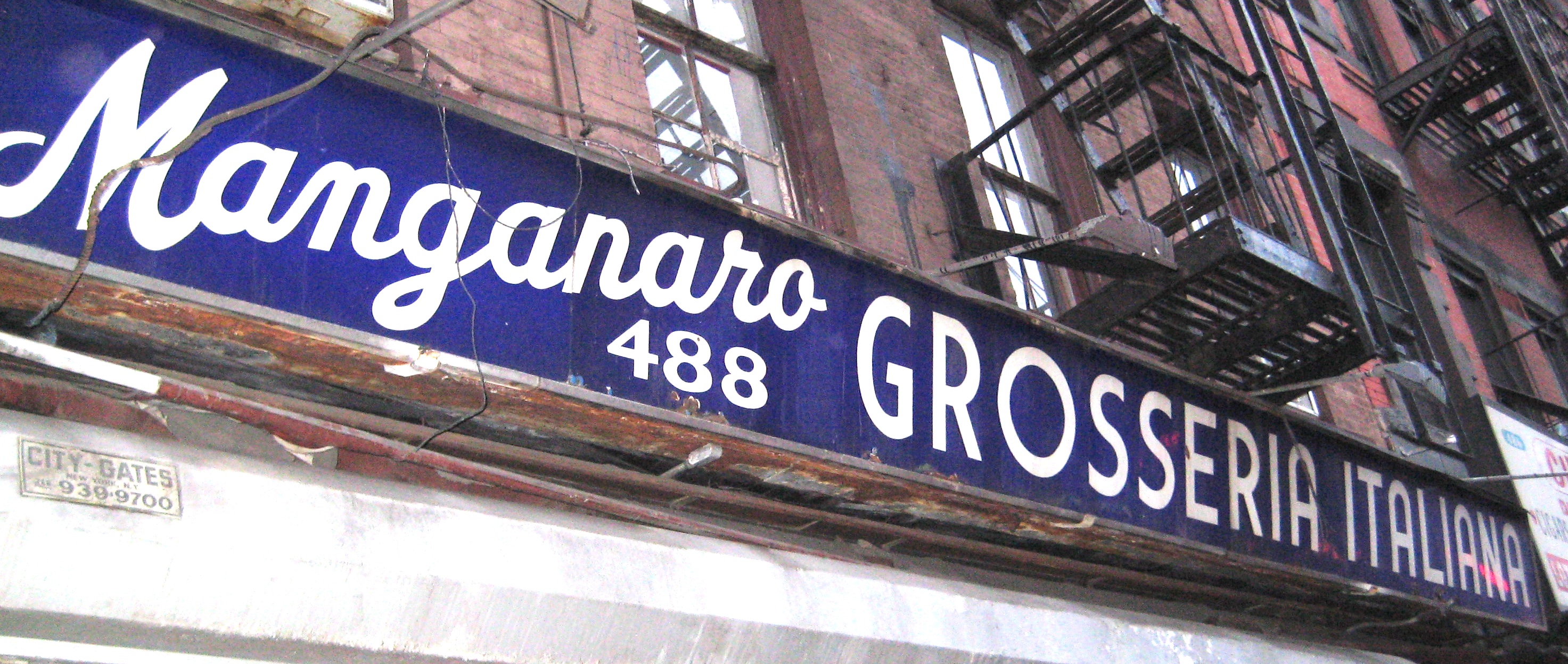
First Avenue, Italian Harlem.

In these constituency correspondence boxes – a goodly portion of the collection – can be heard, or read, the voice of the people Marcantonio represented.

The letters evidence the level of service he rendered them and the deep trust with which they shared their misfortunes. Utterly vulnerable, they approached Marcantonio, not for policy or advocacy, but for mercy. 

There are hundreds of letters and responses alike in the boxes which bring into full relief the radical congressman's personal touch to representation. 

A Constituent.
Here are culled a few of the plentiful kind that earned Marcantonio the sobriquet, “Bread of the Poor.”

“We are a family of 6 and my husband is a WPA worker earning $13.20 a week,” wrote Mary D'Ambrosio of 309 E. 106th St. “We would appreciate your help on Christmas. Please don't forget us we will be waiting.”

Ms. D'Ambrosio's epistle conveys to Marc both the importance and the inadequacy of the WPA program to a working family. 

Marcantonio regularly distributed to his constituents' gift baskets with toys and food for the Holidays. Rose Tudesco of 1974 Second Avenue was so aware of this fact she doesn't even specify the basket.


Little Italy street scene.
"Dear Vito Marcantonio, I am a poor woman. I have 3 children. I used to work and now I have no job. My husband is sick and he is in the hospital. I get no help from no place. I have no money to buy any food, toys or clothes. Try to make it a happy Christmas for my children and me. Thank you. Respectfully yours.”

In this next letter, Alexander Fraskella manages to roll his illness, his need both for a Christmas basket and a new job, into a tightly woven two-sentence message.

“Hon. Vito Marcantonio, Dear Sir, I wish you remember me with a basket for Christmas as I have been home sick this week expect to go back to work next Wednesday Dec. 1 as labor on WPA.
P.S. I received a letter from WPA that they have no vacancy for the watchman's position.”

In response to a request for help, a constituent would usually receive a letter such as this one:
Italian family doing piecework at home.


“Dec. 5, 1940

My Dear Mr. [Joseph] Coniglio (of 231 E. 106th), I am in receipt of your letter and wish to inform you that I shall be at the Marcantonio Club, 1679 Madison Avenue, this Sunday, December 8th, and will be glad to see you there at 2:00 p.m in regard to the matter you wrote me about. Sincerely yours, Vito Marcantonio.”

Or such as this: 

Dear Mr. Gonzalez,

I have been told that I can be of service to you with reference to your application for citizenship. I suggest that you go to the Marcantonio Club, 247 East 116th Street, next Wednesday, October 2nd, between 1:00 and 2:00 p.m. Mr. Pizzo will be there at that time and he will talk to you about the application. Sincerely Yours.”

In “They Couldn't Purge Vito” Sidney Shallet of the “Saturday Evening Post” wrote of Marcantonio:
“He is willing to live in their slums, rub elbows with the best and the worse of them, work himself to the end of a frazzle for them. He spends his dough on them, takes up their battles against the landlords, sends his lawyer to get them out of jail. On occasion East Harlem lore has it, he has carried scuttles of coal personally to heatless tenements. Anyone who wants to see him, to clasp his hand or bend his ear, can do so. That, in short, is why Vito is their boy, and why Vito, who, incidentally, sits at the head of one of the tightest, most thoroughgoing, brass-knuckled political machines in the country, keeps getting reelected.”

The constituent letters found in the Marcantonio papers tell us who “they” were in Marc's work.

Vito Marcantonio Forum member Lulu LoLo is researching the letters for a book and play, and has rendered them live as well.

The writing is thick in disappeared urban argot, and textured with rich hand-scripts the likes of which have passed from usage.

Dusty, crumbling texts, they open windows on a forgotten world.

"The Goodfather, (A Novel): The Rising Fall of the Marvelous Marcantonio," can be found here: MARC LIVES!


VMF Screens Oliver Stone's "The Untold History of the United States."

Artwork by Adam Milat-Meyer
The Vito Marcantonio Forum (VMF), recently presented a second installation of director Oliver Stone's documentary, “The Untold History of the United States.”

The VMF screened the second of four chapters from Stone's opus magnum, which cover the period coinciding with Marcantonio's seven-term congressional run and includes the Depression, World War II, and the Korean War.

VMF co-chair Roberto Ragone delivered a reenactment of Marcantonio's address, “How the Marshall Plan Betrayed Democracy: The Case of Italy.”

The event took place at the Mulberry Street Public Library on March 10.

VMF member Al Freda said the documentary loosely parallels a book of the same title co-written by Stone and Peter Kuznick, and “reveals, or better, exposes all the facts which are intentionally omitted from standard histories of the U.S. of Amnesia – Gore Vidal's appropriate designation for the U.S.”

The next screening will take place April 14. Chapter three is entitled, "The Bomb." It will be followed by another May 12; both at the Mulberry Street Public Library, 10 Jersey Street.

Triangle Shirtwaist Fire Anniversary

The VMF is urging members and friends to join Remember the Triangle Fire Coalition March 25 in marking the tragedy's 107th anniversary.

The commemoration will take place at the corner of Washington Place and Green Street (just east of Washington Square Park) and run from 11:30 to 1 p.m.

The fire took the lives of 146 people - garment workers - 123 of them women, mostly Italian and Jewish in origin.

VMF co-chair Gerald Meyer notes that, “On this day we remember these victims and pledge to redouble our fight to rebuild the union movement and political organizations capable of protecting the lives and livelihoods or workers – native-born and foreign-born, men and women – Americans all.”

The Vito Marcantonio Forum is an associate of the coalition and a financial contributor to its efforts. 


Coalition member Annie Rachele Lanzilloto will launch a double book of memoir poetry and short prose, "Hard Candy: caregiving, mourning and stage light," and "Pitch Roll Yawl" (Guernica), with a Prosecco tasting at NYU Casa Italiana Zerilli-Marimo, 24 West 12th Street, New York City. The event takes place on March 22 at 6 p.m. She'll read again, along with poet Mia Fama', at an April 14 event in which the Italian American Writers Association will celebrate its 27th anniversary. Sidewalk Café, 94 Avenue A, Sixth Street, East Village, New York City 10009. 

VMF co-chair Roberto Ragone will play a prosecuting attorney in the play, "A Cop Shot My Son" at the Sonnett Theater at the Producer's Club, 358 W. 44th St., between 8th and 9th Avenues. Wednesday through Saturday at 8 p.m. and 3 p.m. on Sunday. The dates are March 21-March 26. Tickets are $15. 


VMF Member Lulu Lolo will perform in "Art in Odd Places: Matter," at the University of Virginia in Charlottesville on April 5 and April 6. 

"The Goodfather (A Novel): The Rising Fall of the Marvelous Marcantonio," can be found here: MARC LIVES!


Tuesday, February 13, 2018

Benjamin Franklin High School: In Defense of

Testimony of Roberto Ragone, co-chair, Vito Marcantonio Forum, regarding Benjamin Franklin High School, before the New York City Landmarks Preservation Commission, Feb. 13, 2018, One Centre Street, Manhattan. 

On behalf of the Vito Marcantonio Forum (VMF), an historical/educational organization advancing the history of Italian Harlem and El Barrio - particularly the era when Mayor Fiorello La Guardia, Rep. Vito Marcantonio and Leonard Covello, principal of Benjamin Franklin High School, took the lead on education in the community. 

We advocate the landmarking of Benjamin Franklin High School for a variety of reasons. Many of these reasons resonate personally for myself as an Italian American who grew up in a diverse neighborhood with African Americans and Puerto Ricans, and who studied public policy at the Harvard School of Government, who has worked in government and serves as co-chair of the Vito Marcantonio Forum (VMF). 

Leo Covello at work. 
Leonard Covello (1887-1982) became the first Italian American principal at a time when Italian Americans were discriminated against and viewed as not being able to achieve academically. 

Covello was able to gather a "dream team" of qualified teachers to carry out his theory of community-centered learning. 

This meant a school that kept kids off the streets, a school as a one-stop center where children could engage in extracurricular activities for personal development and maturity and where busy parents learned English, civics, voting and how to become actively involved in their local community. 

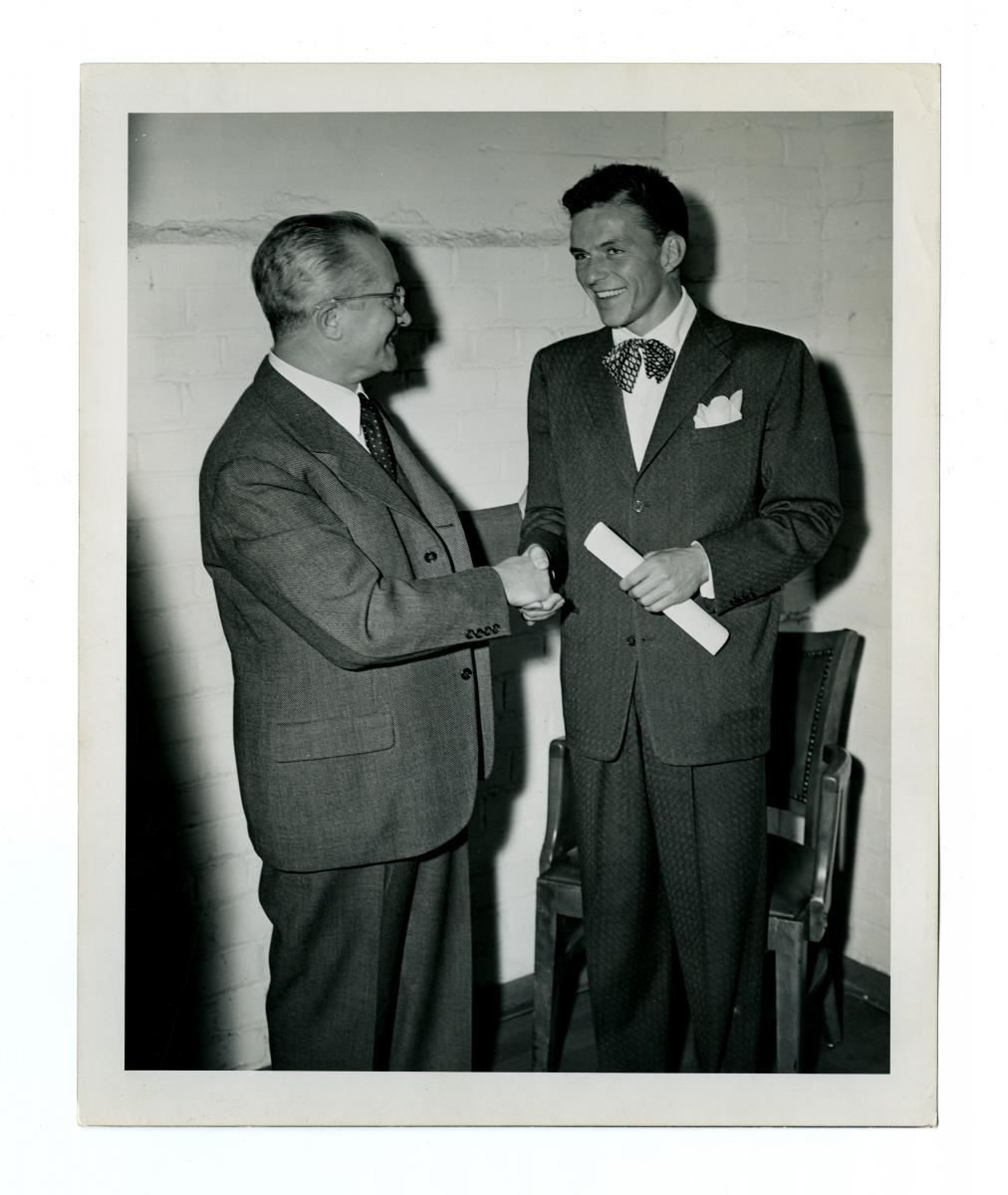
Covello with "Ol' Blue Eyes."
While the broader society derided immigrant culture, Covello made Italian a Regents language and applied an effective form of bi-lingual education and cultural pluralism to foster learning and acculturation, strengthening the connection between heritage and becoming American. "Pop" as Marcantonio called him, further bridged the gap between immigrant children and their parents as well as among people of all races, creeds, and backgrounds. 

In fact not only was Benjamin Franklin High School, historically, a case study for innovative education. It also demonstrated how progressive leadership might diffuse racial or cultural tensions. 

In September 1945, newspapers hyped a scuffle between African American and Italian American students and threatened the school's reputation built by Covello over many years as principal. Springing into action, Covello, Marcantonio and La Guardia got Frank Sinatra to sing at the school and speak to the kids about racial harmony in the auditorium. 
Roberto Ragone as Vito Marcantonio. 

The Italian- and African American students, together with the Puerto Rican kids, ended up marching arm-in-arm at the Columbus Day Parade. Covello even managed to get a photograph taken with Frank Sinatra. 

The building itself, brainchild of LaGuardia appointee Eric Kebbon, was designed in the Georgian revival style, faced with brick and limestone, and laid down symmetrically in classic Greek and Roman styles. 

Within the confines of this structure which did so much to elevate a riverside tenement slum, Covello laid out a hypothesis about learning and then managed to test it as teacher and principal. He introduced an innovative form of learning: learning by experience, by practice, by action, by participation in civic affairs. He demonstrated that theory in application was what mattered. He understood that learning by immersion was what mattered.

Through Benjamin Franklin High School, Covello changed the way we think about school. It was more than book knowledge or vocational training. It was about how children can transform their own personalities to become imaginative, creative, and entrepreneurial for themselves, their families, their community and the broader society.

The staff of a school and the school building itself can foster a larger sense of purpose. The school was, and is, a beacon of hope worthy of landmark status. 

"The Goodfather," (A Novel): The Rising Fall of the Marvelous Marcantonio" can be found here: MARC LIVES


Tuesday, January 9, 2018

The Vito Marcantonio Lucky Corner

Marc's Lucky Corner Legions. 
New York City now has its long-overdue “Vito Marcantonio Lucky Corner” and Professor Gerald Meyer has a new job to do.

In his biography of Marc, Meyer concluded with a strong lament: “No plaque commemorates the place of his birth, his political headquarters, his adult residence, or the spot where he fell dead.

“Nevertheless, his story deserves to be known, because it contradicts so many of the platitudes which pass for American history and therefore suggests new ways of thinking about the present.”

Offended by the forgetfulness, driven by his belief in the need for Marc's revival, Meyer convened the Vito Marcantonio Forum (VMF)in October of 2011.

Among those present on that night, as the Occupy movement took root in downtown Manhattan, were current members: Rita (Pura) Barakos; Charles Bayor; Gil Fagiani; Dave Giglio; Maria Lisella; Meyer; Roberto Ragone and Stephen Siciliano.


Among the goals set at the founding meeting was the naming of a street after the radical congressman.

On Dec. 17, the milestone was realized. The VMF's persistence in making Marcantonio part of the intellectual and cultural conversation, coupled with the commitment of city council president Melissa Mark-Viverito, made it happen.

The outgoing councilwoman's district overlaps much of what was Marc's old 18th, and then 20th, congressional districts. Throughout her term Mark-Viverito's office kept the ends out for ties that bound it to the VMF.

In March of 2017, the group honored her with the Vito Marcantonio Award. 

The fruitful relationship finally resulted in a most-poignant day for Marc and those who have endeavored to keep his flame burning.

“I have remembered,” Mark-Viverito told those gathered on a chilly Sunday afternoon at the corner of Lexington and E. 116th Street, “those who came before me and guided me as I moved forward representing East Harlem and the South Bronx: Adam Clayton Powell, Jr., Evelina López Antonetty and Vito Marcantonio – all champions of the working class.”

Artwork by Adam Milat-Meyer.
“The naming of the street could not come at a more appropriate time in the country's history,” said VMF co-chair Lisella in a joint press release with the New York City Council. “As the rights of the immigrants, the poor, and social services are being challenged, we hope the reminder of Congressman Vito Marcantonio will inspire people and politicians to model themselves on his example.”

The event was attended by Manhattan Borough President Gayle Brewer. Chris Bell recited the late Gil Fagiani's “Litany of San Vito” in English, Lisella did so in Italian, and community activist Gloria Quiñones performed the Spanish rendering.

VMF Co-chair Ragone reenacted a speech given by Marcantonio on the hallowed spot during his 1949 campaign, as well as passages from others on Puerto Rican independence and the discrimination of Italian immigrants. 

Meyer spoke on the significance of the Lucky Corner and pledged the group's continued effort to erect memorials at other sites of importance to the East Harlemite's career.

"The Lucky Corner," one of Ralph
Fasanella's masterworks.
In “La Guardia: A Fighter Against His Times,” author Arthur Mann traces the landmark to “The Little Flower's” 1924 congressional run:

“Fiorello closed his campaign on the night before election with a parade featuring fireworks, torches, and music, which wound up on 116th Street and Lexington Avenue – to be known thereafter as the Lucky Corner. Once again the streets rang to the tune of 'On the Road to Mandalay' as The Major's tenors, sopranos, and bassos sang out: 'Fi-or-el-lo H. La Guar-di-a; Harlem needs a man like you in Congress.'”

Marcantonio assumed La Guardia's mantle in Congress – and at the Lucky Corner – when The Major became The Mayor.

There were adjustments. The song became “The Hymn of Garibaldi,” but the party still ended with an appearance by the man-of-the-hour, Marc.

L-to-R: Frank Marcantonio, Gale Brewer, Melissa Mark-Viverito,
Christopher Bell, LuLu Lolo Pascale, Gerald Meyer, Gloria

Quiñones and Roberto Ragone.
In “Vito Marcantonio: Radical Politician,” Meyer writes, “The Lucky Corner, by its very name, evoked the huge reservoir of folk beliefs equality prevalent in Italian Harlem and El Barrio. It also created the sense of the festa/fiesta, which, organized around an icon, celebrates a community and its deepest, often unarticulated beliefs and longings. Like the festa/fiesta, this pre-election rally had a major ritualistic, ceremonial function, which among other things stated that the streets and the public places belonged to the community residents, that their narrow, often dead-end lives had a wider meaning.”

Miriam Sanders may have fallen in love with her future husband after being “electrified by his incisive and compelling oratory” during a 1924 speech at the Lucky Corner, according to Meyer. Ralph Fasanella turned a Marcantonio rally at the locale into one of his masterworks. 

The story of the new sign at the Lucky Corner is as much about the marker as it is about the Vito Marcantonio Forum.

A long time in coming: Gerald Meyer. 
“The VMF,” says Meyer, “is a cross-generational, multi-racial/ethnic, gay-straight group of folks from varying political proclivities united in our conviction that the life and times of Vito Marcantonio must be written into all the phases of American history to repair the damage of the Cold War and McCarthyism which still haunt our national consciousness and behavior.”

Since its founding, the VMF has elaborated a rigorous program of interventions intellectual, literary, musical, and theatrical, thrusting forth from obscurity the name and work of Vito Marcantonio to those who come to be reminded and those who come to learn.

These have been auto-generated events, symposia in collaboration with like-minded groups, and forums convened by other organizations.

Reenactment, recital, poetry, musical spoken word, street corner speeches, film screenings, videos, guest speakers are all part of the VMF's toolbox.

The group has participated in, or mounted, 40 events since 2011, reviving the name of a man about whom very little was written or uttered.

An assembly of writer-, actor-, poet-, historian-, lawyer- retiree-activists, and such, with no official charge, but persistent and skilled at messaging through text, stage and screen, established a metric for success and pursued the matter to its fruition.

Roberto Ragone and Frank Marcantonio. 
The Lucky Corner's dedication represents Marcantonio's legacy redounding upon itself, his example of a citizen-based, collective activism being put to use in a way that could not have failed to please him. 

The event was written up in “AM/NY,” the Italian-language “i-Italy,” “People's World,” “24 New York,” and what appears to be a German language publication.


Renato Cantore wrote up the event in his Italian-language website as well as in "La Gazzetta del Mezzogiorno." 

A member of the VMF, Cantore has visited Avigiano and Potenza, the respective hometowns of the Leonard Covello and Marcantonio families. The city fathers of both locales take pride and seek to make known the connections. 

Frank Marcantonio, a descendant of the East Harlem congressman, wrote VMF members saying, "It was a wonderfully exciting day highlighted by the unveiling of the 'Lucky Corner,' a lasting tribute to the life and legacy of Vito Marcantonio and also a legacy to all those who have persevered over the years to keep his name and accomplishments alive.”

Leading up to the sign ceremony was a Dec. 10 reading of Clifford Odet's “Waiting for Lefty” in conjunction with Work of Art Productions. 

It is Odet's first important play written in "The Red Decade," and stands as a textbook example of a successful, socialist-realist production. 

Four members of the VMF participated in the production. Ragone played the character "Joe," whose wages are insufficient to meet his needs. Bell played "The Villain." Meyer presented a talk on the aesthetics of the politicized theater. Adam Milat-Meyer handled the lighting and sound. 

Following the sign event the VMF held its ninth and final session of a reading circle done in conjunction with the neighborhood activist group Chelsea Rising at Penn South.

The cycle, which featured writings and speeches from “I Vote My Conscience,” ended with a special session focusing on Puerto Rico.

Artwork by Adam Milat-Meyer.
In attendance was Alma Concepción who, aside from the blessing of being Marc's godchild, was the only daughter of Gilberto Concepción
de Gracia, described by Meyer as “a major figure in Puerto Rican history.”

Concepción was, among other things, co-attorney with Marc in defense of Pedro Albizu Campos and other Nationalist Party leaders against sedition charges, and founder of the still-vital Puerto Rican Independence Party.

The hoisting of that green sign over the emblematic East Harlem street corner strengthens the bond between those who dreamed, and then lived, the process of memorializing the Lucky Corner and primes the VMF as it moves beyond its most active year in existence.


"The Italian American Table: Food Family, and Community in New York City," by Simone Cinotto


No, the pasta with tomato sauce and a side of sausage and/or meat in more gravy/sauce you eat on Sunday is not a time-honored recipe of your Old Country forebears.

In “The Italian American Table,” Simone Cinotto proposes that the food we know as “Italian” has roots in the Old Country, but actually flowered in New York City.

Cinotto's academic examination of New York City's Italian immigrant community peels back the layers of accumulated culture to be found in that construct we know so well as “Italian food.”

The book proposes that, “Italian food was the food that reflected the experiences of Italian New York, as it was reinterpreted, transformed, and perpetuated in different reincarnations of many different Italian cuisines.”

What that means is that Italian food is not born of traditional recipes persistently defended by immigrants against modernity, but a creative response to the challenges of life in the New World. 

A Creative Business Class

Much of the credit goes to dynamic Italian American entrepreneurs whom Cinotto has called, “less cultural conservatives and more creative innovators.”  

This business class, he says, provided the community with a self-sufficiency in terms of goods. The goods themselves nurtured the culture and created a powerful link between being Italian and shopping Italian.

“They created a culture and a material world that was important for them,” says Cinotto, a member of the Vito Marcantonio Forum. “This mostly symbolic cultural construction would not have survived if it were not very important in economical terms.”

Fortuitously coupled to the business acumen of these merchants was a very large market for goods from Italy or “Italian-made” product. The 1930 census revealed one-in-six New Yorkers were Italian.

Abundance Realized


As for the Italian American diet's progression, he informs that, for the immigrants, pasta, canned tomatoes, olive oil – items now sacrosanct – became part of their diet on this side of the Atlantic. 

“[The immigrants] predilection for fresh food,” Cinotto says, “which they never seemed tired of declaring, may well have been the result of not having much of it in Italy, where, contrary to popular notions, southern peasants rarely ate 'fresh' and 'in season,' relying mostly on cereals (bread, soups, pastas or pulses), and poorly preserved cheese, fish and sausages.”

Meat in Italy was a sometime thing. Manufactured “dry” pasta was for the upper strata of society.

The immigrants did not consider themselves as coming from Italy, rather as migrants sprung from their piccolo paese, “little country,” or province.

http://marcantoniana.blogspot.com/2013/12/wheres-marc-in-literature-michael.html
Simone Cinotto. 
Michael Parenti recalls in "Waiting for Yesterday," his memoir of youth in East Harlem, that when he asked his father if So-and-so was a paesan, his father told him, "No, he's Napolitan," meaning he was not Barese, like the Parenti clan and not of the same paese.

The food they ate represented what their sending region could yield or trade for. They shopped in local stores trafficking in the imported foodstuffs from the same places. 

But their U.S. status was that of Italians and the second and third generation kids came to view themselves in that way. They went to DeWitt Clinton High School where there were Irish kids, African-American kids, Puerto Rican kids, Jewish kids and themselves... the Italian kids.

A Closed Circle of Consumption

The home was a different story. “Living frugally in ethnically bounded enclaves, they maintained highly distinctive foodways,” says Cinotto. “In their homes, Italian immigrant women, barely exposed to mass marketing and advertising, continued to prepare foods purchased in local, independent stores in the neighborhood.”

This, he calls, a “closed circle of consumption,” which endured in immigrant communities up until the Second World War. It meant that mass-produced foods and chain stores made few inroads into the eating habits of Little Italy.

“Even as the U.S. marketplace allowed migrants to enrich their daily fare with foods (such as white bread, pasta, meat, coffee, and sugar) that had long been out of reach in Italy, their isolation and poverty shielded them from most of the lure of mass culture, mass consumption, and mass advertising,” according to Cinotto.

Nonetheless, he observes, “their ethnic food production and distribution network allowed immigrants to have much wider access to more varied food than they had in rural Italy. The industry that brought 'Italian' foods to Italian enclaves was just one part of a complex, global trade system.”

American production techniques meant food was getting to the table cheaper than elsewhere in the world, and certainly cheaper than in Italy. “Hard-pressed immigrants saw some of the abundance promised by America in the availability of products beyond their reach back home,” says Cinotto. 

The Importance of Food

Italian American families of that time, Cinotto's research revealed, spent significantly more on the family food budget than other ethnic groups in the U.S.

Food was important, part of southern Italian hospitality. So was tradition, but the immigrants found that keeping their American-born children in line as to the old ways was a losing battle.

Parenti writes, “The immigrant men drank wine made in their own cellars and smoked stogies. We nasty youngsters called the stogies 'guinea stinkers' in reference to the old Italians who smoked them.”

The “nasty youngsters'” immigrant parents turned to food as the glue that would preserve the family from the corrosive effects of modern American culture.

Cinotto notes that, “Immigrants began to employ food and food rituals in the construction of the Italian American famiglia with its emphasis on solidarity, strong gender roles, a commitment to work, suspicion toward abstract ideas, and an appreciation of the effective limits of happiness."

He observes that, "The ideology of La Famiglia met the needs of working-class culture - itself under development - that prepared individuals to the life of labor most of them were destined to live." 

For Italian Harlem's immigrants, Cinotto says, a woman's ability to prepare the beloved foods was a sign of successfully transmitted tradition across generations.

"In practice,' he adds, "it meant that the new bride was ready to serve her new husband the food his mother used to cook." 
Marc cared about spaghetti.

Sunday dinner was very important. The foods served were not to be found in the American culinary universe the children encountered at school and in the homes of American friends. It therefore served as a strong symbolic link to the family and to that family's identity as Italian. 

To Be, or Not to Be (Italian)

As Parenti remembered, his grandfather, in the end, expanded his language comprehension of the standard Italian, used in local papers like Il Progresso, until he became less a Barese and something of the Italian he had never been in Italy.

It is Cinotto's proposition that much the same progression affected the Italian American diet.

After World War I, the community's wealth, much of which used to be sent to family in Italy, stayed in New York, and provided Italian American businesses with access to new capital.

A new generation of medium- to large-sized Italian American commercial entities then, “helped reshape the Italian American market by adding their ethnic social and cultural capital to modernized methods of production and marketing; they managed to create an aura of Italianitá around their products by asserting the Italian identity of their products or inventing one where it did not exist, while at the same time meeting the standards required by modern consumer culture – low price, quality, purity, and ease of preparation.”

Even when the canned tomatoes came from a California company, or the salami from northern New Jersey, branding industrially produced mass products as Italian worked, and these became every day items in the Italian American kitchen, in Cinotto's words, “earning the same trust accorded to 'natural' and 'traditional' non-processed foods." 

Marc frequented Rao's.
You'll never grab a can of whole tomatoes again without reading the label after Cinotto takes you through his survey of U.S.-sourced “Italian” kitchen staples. Just because there's a folkloric drawing of a peasant woman holding a basket in the Italian countryside, doesn't mean the contents comes from the Italian countryside.

A Comprehensive Study

There's much more. The role Italian restaurants served in helping Americans get more comfortable with the people who owned them and vice versa. Mussolini's encouragement of importation to the Italian immigrant community and the move toward Italian American companies when the trade bonanza ended.

There is a look at the codification of an “Italian cuisine” - designed more for Americans than Italians - featuring Neapolitan tomato-based offerings and dishes devised on Mulberry Street or 116th Street, home of Rep. Vito Marcantonio; a dedicated marinara man in his own right. 

The progression, or the dialectic, is ongoing.

Mario Batali rooted his haute cuisine in the Old Country proper and would not hire kitchen hands who had not done time in an Italian – as in Italy – restaurant. There was a response, with cookbooks like “We Called It Macaroni” reasserting the virtues of home-cooked New York-style Italian cuisine.

All of which serves to highlight the dramatic levels of out-migration from Italy to the Americas. Cinotto often employs the term “diaspora” to describe the displacement of southern Italians around the world.

The condition was one of uprootedness and the establishment of foodways that drew upon old habits and made concessions to the offerings of a new environment resulted in something newer still: a strong marker of Italian American identity. 

Cinotto teaches history at the University of Gastronomic Sciences in Pollenzo, Italy. He is the recipient of accolades for his studies of food and the Italian American experience.