Showing posts with label Leonard Covello. Show all posts

Tuesday, February 13, 2018

Benjamin Franklin High School: In Defense of

Testimony of Roberto Ragone, co-chair, Vito Marcantonio Forum, regarding Benjamin Franklin High School, before the New York City Landmarks Preservation Commission, Feb. 13, 2018, One Centre Street, Manhattan. 

On behalf of the Vito Marcantonio Forum (VMF), an historical/educational organization advancing the history of Italian Harlem and El Barrio - particularly the era when Mayor Fiorello La Guardia, Rep. Vito Marcantonio and Leonard Covello, principal of Benjamin Franklin High School, took the lead on education in the community. 

We advocate the landmarking of Benjamin Franklin High School for a variety of reasons. Many of these reasons resonate personally for myself as an Italian American who grew up in a diverse neighborhood with African Americans and Puerto Ricans, and who studied public policy at the Harvard School of Government, who has worked in government and serves as co-chair of the Vito Marcantonio Forum (VMF). 

Leo Covello at work. 
Leonard Covello (1887-1982) became the first Italian American principal at a time when Italian Americans were discriminated against and viewed as not being able to achieve academically. 

Covello was able to gather a "dream team" of qualified teachers to carry out his theory of community-centered learning. 

This meant a school that kept kids off the streets, a school as a one-stop center where children could engage in extracurricular activities for personal development and maturity and where busy parents learned English, civics, voting and how to become actively involved in their local community. 
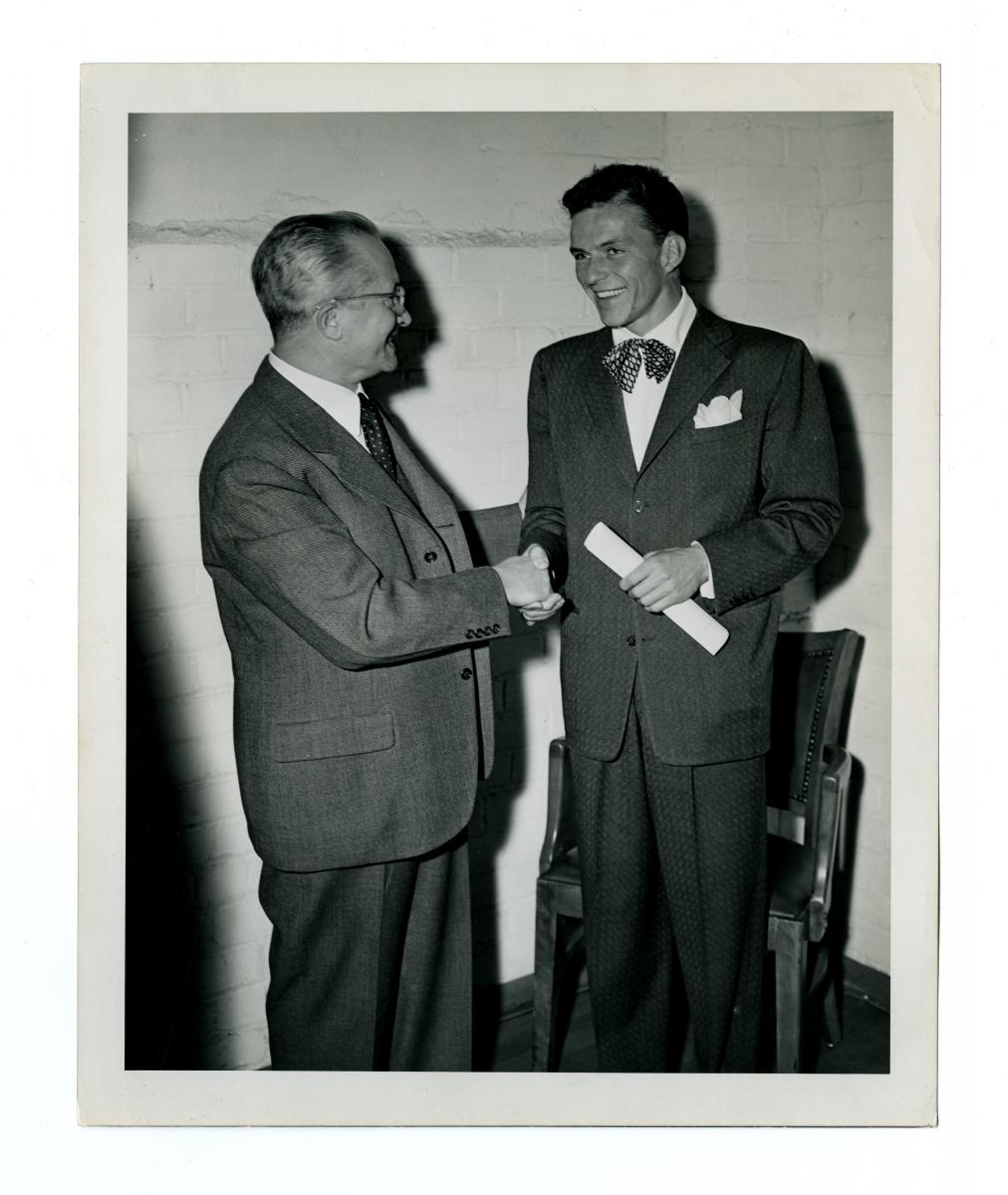
Covello with "Ol' Blue Eyes."
While the broader society derided immigrant culture, Covello made Italian a Regents language and applied an effective form of bi-lingual education and cultural pluralism to foster learning and acculturation, strengthening the connection between heritage and becoming American. "Pop" as Marcantonio called him, further bridged the gap between immigrant children and their parents as well as among people of all races, creeds, and backgrounds. 

In fact not only was Benjamin Franklin High School, historically, a case study for innovative education. It also demonstrated how progressive leadership might diffuse racial or cultural tensions. 

In September 1945, newspapers hyped a scuffle between African American and Italian American students and threatened the school's reputation built by Covello over many years as principal. Springing into action, Covello, Marcantonio and La Guardia got Frank Sinatra to sing at the school and speak to the kids about racial harmony in the auditorium. 
Roberto Ragone as Vito Marcantonio. 

The Italian- and African American students, together with the Puerto Rican kids, ended up marching arm-in-arm at the Columbus Day Parade. Covello even managed to get a photograph taken with Frank Sinatra. 

The building itself, brainchild of LaGuardia appointee Eric Kebbon, was designed in the Georgian revival style, faced with brick and limestone, and laid down symmetrically in classic Greek and Roman styles. 

Within the confines of this structure which did so much to elevate a riverside tenement slum, Covello laid out a hypothesis about learning and then managed to test it as teacher and principal. He introduced an innovative form of learning: learning by experience, by practice, by action, by participation in civic affairs. He demonstrated that theory in application was what mattered. He understood that learning by immersion was what mattered.

Through Benjamin Franklin High School, Covello changed the way we think about school. It was more than book knowledge or vocational training. It was about how children can transform their own personalities to become imaginative, creative, and entrepreneurial for themselves, their families, their community and the broader society.

The staff of a school and the school building itself can foster a larger sense of purpose. The school was, and is, a beacon of hope worthy of landmark status. 

"The Goodfather," (A Novel): The Rising Fall of the Marvelous Marcantonio" can be found here: MARC LIVES


Tuesday, July 22, 2014

Commemorating the 60th Anniversary of Vito Marcantonio's Death


Those who remember, and believe in, the life's work of Rep. Vito Marcantonio (ALP) will gather at his grave-site Aug. 9, to commemorate the 60th anniversary of his death.
The Vito Marcantonio Forum is convening all those who share their fondness for the radical politician at Woodlawn Cemetery in the Bronx for the second year running.

The group was formed on Oct. 11, 2011 and has made great strides in bringing the almost forgotten congressman from East Harlem back into public consciousness and contemporary political debate.

The 1 p.m. event (rain date Aug. 16) will feature remarks by professor and author of “Vito Marcantonio: Radical Politician,” Gerald Meyer. Actor and writer Roberto Ragone will dramatize a Marcantonio speech, and actor Troy Hodges will interpret Paul Robeson's eulogy to the progressive lion.

Marcantonio died of cardiac arrest in the stairwell of the City Hall Park subway station on Aug. 9, 1954. He had launched, in February of the same year, the Good Neighbors Party, and unofficially announced his plans for a run at his old congressional seat in July. He was heading to city hall with election-related business when he expired in a rainstorm.

Marcantonio was just 51 years of age.
In his piece, “Italian Harlem's Biggest Funeral: A Community Pays Its Last Respects to Vito Marcantonio,” professor Meyer wrote, that on the day following his death, “in Giordano's funeral parlor from 12:30 until 11:30 that night and the following day from 9 a.m. until 11 p.m., a procession of openly weeping people passed by the bier at a rate of one thousand per hour.”
The Constituency

Windows of tenements and stores hung out black wreathes and black-bordered signs which read: “We Mourn Our Loss.”

The day of his funeral, Aug. 12, police blocked off First Avenue at East 115th Street to permit passage of a funeral procession in excess of 100 vehicles led by fifteen, flower-laden coaches. 

It was estimated that 10,000 lined the streets of East Harlem. 

“Everything, except perhaps its enormous scope and extravagant expression, of loss resembled the typical funeral of a prominent son of a traditional Italian-American community,” wrote Meyer. “Funerals represented the most important ritual moments for this community, the situation around which the community reassembled and reassured itself. It constituted the ultimate assertion of the Italian way of life as transported to America. Italian Harlem gave Marc its most spectacular funeral because he was their most loyal son, it's most fervent defender.”


The multiracial/multi-ethnic character of the crowd of mourners was reflected in the composition of the honorary pall bearers.

They included: Marc's boyhood friends, (Frank Maurelli and Vincent Velella); leaders of Italian Harlem (Leonard Covello and Joseph Baccia); Puerto Rican leaders (Manuel Medina and Gilbert Concepcion de Gracia); African-American leaders (Andronica Jacobs and W.E.B. DuBois; communist leaders (Ben Gold and John Abt); famous leftist (former Minnesota Gov.) Elmer Benson and Corliss Lamont.
From the "New York Times"


Many nonItalians participated in the solemn proceedings, proof, Meyer stated, of Marc's record as a congressman, which was focused on helping those in need, regardless of race, ethnicity or economic station.

W.E.B. DuBois eulogized Marcantonio as, “one of the clearest thinkers in Congress” and “a politician in the finest sense of the mutilated word. He was not a capitalist and not a communist. He wanted Americans to have the right to live as they saw fit. He believed in socialism as exemplified by the New Deal. He believed in severe control of predatory wealth which rides roughshod over the poor. In this era of national cowardice, here were not many of his courage.”


His lifelong friend and barber Luigi Albarelli mourned, “Your name will ever remain in the story of the great martyrs who fought for the cause of justice. Your life has been a mission. Your life was ever dedicated to lighten the load of the people who were in need. You lived fearlessly and courageously with affection in your heart for the common man. You were a man of the people and the people love you. A rivederci!


In the “New York Times,” one Joseph Louchheim wrote a letter-to-the-editor proclaiming, “Marcantonio, to put it mildly, was not a statesman, but as a Congressional Representative few, if any, could match his knowledge of his district and his loyal, whole-hearted, conscientiousness.”


New York “Power Broker” Robert Moses wrote Marcantonio's wife Miriam: “Mary and I were both very fond of Marc and so were our girls. We all agreed that he was one of the kindest people we had ever met and, while his philosophy was quite beyond us, we will still miss him.”


In the U.S. House of Representatives Rep. Herman Eberharter (D-Penn.) joined a choir of congressional mourners in observing that, “Of his many attributes, what impressed me most in my personal contacts with him was his true concern for the oppressed, for those who were among the less fortunate, his ever-ready sympathy for the poor and downtrodden. I believe that he was possessed of a good heart and a pure soul, and our memory of him, as we saw him in action on the floor of this House will be to many of us an inspiration, for without doubt he possessed exceptional ability coupled with immense strength of character...”
Marcantonio was denied burial in a Catholic cemetery by Cardinal Francis Spellman. Meyer asserted that a mixture of Red Scare and prejudices against Italian Catholics held by those in the primarily Irish hierarchy was behind Spellman's decision.

“It was as if the community had regressed to the years between 1884 to 1919,” Meyer wrote, “when in Our Lady of Mount Carmel, which they had built with their own hands, the pastors had relegated services in Italian and the Madonna to the basement – the church inferior.” (la chiesa inferiore).

The Italian Catholics responded to Spellman in the way they did to many such slights, by going their own way.

“Catholic lay people tried to repair some of the damage done to Marcantonio,” wrote Meyer. “Hundreds of mass cards filled the funeral home and several societies affiliated with Our Lady of Mount Carmel Church hired autos for use during the funeral procession. Dorothy Day in the Catholic Worker movement's monthly wrote an extended obituary that declared Marcantonio would be remembered because, in the words of the psalms, “he understood concerning the needy and poor.”

The Vito Marcantonio Forum event is only the latest effort to credit the barber Albarelli's words, holding symposia on the congressman's relationship with the Puerto Rican people, his contribution to left-wing political thought and action, highlighting the work of his mentor Leonard Covello, and much more.

Please join the Forum in the Bronx on Aug. 9, and help keep Marc's name, “in the story of the great martyrs who fought for the cause of justice.”

Wednesday, February 12, 2014

Leonard Covello


The Vito Marcantonio Forum (VMF) is having a book party, dramatic reading and discussion of Leonard Covello's "The Heart is The Teacher on February 22 (2014) at the Mulberry Street Branch of the New York Public Library.

The occasion is a reissuing of the book by the John D. Calandra Institute. 

Professor Gerald Meyer wrote the afterword and will speak on the reform educator's pedagogical relevance in today's multi-cultural society.

LuLu LoLo will dramatize passages from the book. Roberto Ragone will "take on Vito Marcantonio's perspective as the seven-time elected congressman from East Harlem was a close friend to Covello," according to a VMF flyer for the event.  

The branch library is located at 10 Jersey Street, corner of Mulberry and Prince streets. The event will begin at 2 p.m. and run approximately two hours.

Below are reviews of the "The Heart is the Teacher" and "Leonard Covello and the Making of Benjamin Franklin High School."


"The Heart is the Teacherreads as clear-headed and purposeful as the man it describes.

Its string of anecdotes are rendered in a straight-ahead, clean prose, chronologically scripted from educator Leonard Covello's earliest days in the Italian village of Avigliano, to his retirement from the New York City school system.

It is a narrative which deals only in the essential and does the good job of conveying his ideas.

"The Heart," does a marvelous mapping of the disconnect endured by those who left pre-industrial, rural Italy to settle in urban ghettoes like Manhattan's Lower East Side or East Harlem.

There is much pathos in Covello's story. His mother expired from depression born of that chasm between old world and new, which she could not find it in herself to bridge. "Cara Mamma!" he cries
to the reader when recounting her departure.

Similarly, his first love died in the opening phases of their well-suited marriage.

And, of course, as an educator, he bore certain students' failures as fully as he permitted the success of others to fill his sails with wind.

The early chapters fully divulge the difficulties of the Italian-American experience: the gulf between foreign-born parents and their United States-born children; the gap between success Italian-style, via family loyalty, and the American promise of independent self-realization.

And "The Heart..." is also a possible prescription for a particular kind of American success. Covello did not become a wealthy industrialist, but his academic commitment, first as a student and later as teacher, carved out a significant niche as intellectual and policy wonk.

Himself the subject of certain books on education, Covello's approach was hardly rocket science. Socialist of bent, his approach to kids was strictly old school:

"A child," he wrote, "cannot be left to his own devices. He must have discipline, must be given responsibilities. He is a part of the family and the community and must be made to feel from the beginning that he has a duty toward that family and that community."

The start of World War II stunted his efforts at making Benjamin Franklin High School an engine for change in the surrounding East Harlem neighborhood. It convinced him that such violence, however far away, fed his young charges with the same unfortunate inclinations.

Covello's autobiography is terribly understated so that it suffers somewhat from a lack of drama, although his life was hardly devoid of it. But through the narrative's calmness, the reader may be sensing the affect the educator had on those he spent his life trying to help.

"Leonard Covello and the Making of Benjamin Franklin High School: Education As If Citizenship Mattered" dissects American society's move away from the public commons and towards the individualistic principles and private sphere championed in the conservative canon, through the experience of one man at one New York City high school. The authors Michael Johanek and John Puckett recap their effort with the closing question: "How does Covello's theory and practice of community school speak meaningfully to the problem of American's hastening retreat from the public sphere?"

"Leonard Covello and the Making of Benjamin Franklin High School" is a tough academic slog covering the first days of the community school movement, as envisioned by the education theorist John Dewey, and the way it dovetailed with the early 20th Century reform movement in the United States.

It discusses, in adequate detail, certain preliminary thrusts at integrating a school's efforts into the goals of the surrounding community, and their varying degrees of success.

But mostly, and as the title suggests, the book returns to Leonard Covello, an Italian immigrant convinced of education's value to any newcomer's development, and his efforts at applying community school principles in the well-defined terminus of East Harlem, New York City.

The book demonstrates the verity of Emerson's platitude that, "An institution is the shadow of one man," by tracing Covello's efforts at opening a school for the underserved area, teaching Italian to the children of immigrants from Italy, and grooming enough students to generate at least one formidable star - Vito Marcantonio.

Marcantonio gave Covello the nickname by which two generations of high school boys would come to know him - "Pop."


More importantly, he helped his old mentor construct a new public high school on the banks of the East River, secured countless employees from the Depression-era Works Progress Administration to staff it, and stood guard when the experiment came in for conservative attacks.

The meat of the book covers the very specific work Covello and his team did implicating Franklin into the troubled neighborhood's affairs.

These included a sociological mapping of immigrant focal points, exhaustive surveys of area businesses, clean-up campaigns, storefront community centers, communal gardens, parades, dances, and conferences on racial tolerance crucial in a neighborhood where Italians, Puerto Ricans, Blacks, and slivers of other groups cohabitated uneasily.

The book makes clear that putting these ideas in play turned out to be a lot harder in practice than they were to write about in theory.

There is admiration for Covello and his dream, but no whitewashing of his shortcomings nor the fact that the Franklin experiment was largely over even before he retired in 1956.

There is fair analysis of the political winds buffeting attempts at improving East Harlem through the direction of a scholastic hub.

As the progressive '30s gave way to the World War, the ensuing conservative era, and Marcantonio's unseating in Congress, the very idea of "community school" carried the unpopular baggage of socialism and Covello's wings were clipped accordingly.

Finally, the authors draw conclusions about how the failure speaks to education in America today and suggest the circumstances of Covello's time prevailed over principles which were not only sound, but of enduring value.