Showing posts with label Remember the Triangle Shirtwaist Fire Coalition. Show all posts

Monday, March 19, 2018

VMF Screens Oliver Stone's "The Untold History of the United States."

Artwork by Adam Milat-Meyer
The Vito Marcantonio Forum (VMF), recently presented a second installation of director Oliver Stone's documentary, “The Untold History of the United States.”

The VMF screened the second of four chapters from Stone's opus magnum, which cover the period coinciding with Marcantonio's seven-term congressional run and includes the Depression, World War II, and the Korean War.

VMF co-chair Roberto Ragone delivered a reenactment of Marcantonio's address, “How the Marshall Plan Betrayed Democracy: The Case of Italy.”

The event took place at the Mulberry Street Public Library on March 10.

VMF member Al Freda said the documentary loosely parallels a book of the same title co-written by Stone and Peter Kuznick, and “reveals, or better, exposes all the facts which are intentionally omitted from standard histories of the U.S. of Amnesia – Gore Vidal's appropriate designation for the U.S.”

The next screening will take place April 14. Chapter three is entitled, "The Bomb." It will be followed by another May 12; both at the Mulberry Street Public Library, 10 Jersey Street.

Triangle Shirtwaist Fire Anniversary

The VMF is urging members and friends to join Remember the Triangle Fire Coalition March 25 in marking the tragedy's 107th anniversary.

The commemoration will take place at the corner of Washington Place and Green Street (just east of Washington Square Park) and run from 11:30 to 1 p.m.

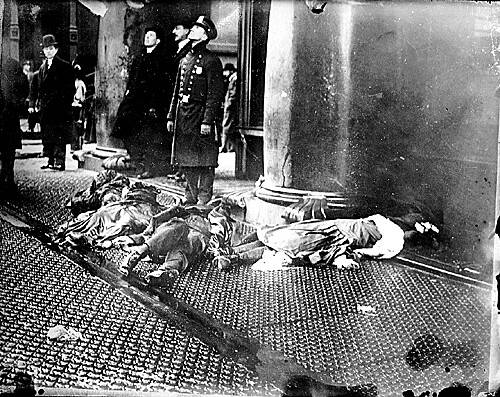
The fire took the lives of 146 people - garment workers - 123 of them women, mostly Italian and Jewish in origin.

VMF co-chair Gerald Meyer notes that, “On this day we remember these victims and pledge to redouble our fight to rebuild the union movement and political organizations capable of protecting the lives and livelihoods or workers – native-born and foreign-born, men and women – Americans all.”

The Vito Marcantonio Forum is an associate of the coalition and a financial contributor to its efforts. 


Coalition member Annie Rachele Lanzilloto will launch a double book of memoir poetry and short prose, "Hard Candy: caregiving, mourning and stage light," and "Pitch Roll Yawl" (Guernica), with a Prosecco tasting at NYU Casa Italiana Zerilli-Marimo, 24 West 12th Street, New York City. The event takes place on March 22 at 6 p.m. She'll read again, along with poet Mia Fama', at an April 14 event in which the Italian American Writers Association will celebrate its 27th anniversary. Sidewalk Café, 94 Avenue A, Sixth Street, East Village, New York City 10009. 

VMF co-chair Roberto Ragone will play a prosecuting attorney in the play, "A Cop Shot My Son" at the Sonnett Theater at the Producer's Club, 358 W. 44th St., between 8th and 9th Avenues. Wednesday through Saturday at 8 p.m. and 3 p.m. on Sunday. The dates are March 21-March 26. Tickets are $15. 


VMF Member Lulu Lolo will perform in "Art in Odd Places: Matter," at the University of Virginia in Charlottesville on April 5 and April 6. 

"The Goodfather (A Novel): The Rising Fall of the Marvelous Marcantonio," can be found here: MARC LIVES!


Tuesday, August 1, 2017

"Activism Matters" Reasons for the Triangle Fire Coalition

Professor Trasciatti

“Remembering the Triangle Fire: Performances, Screening and Presentations,” was held March 24 (2014) at New York University's Casa Italiana. The occasion was the 96th anniversary of the tragedy.

The program included Mary Anne Trasciatti, a professor at Hofstra University and president, board of directors, Remember The Triangle Fire Coalition, who talked about the group's plans and inspirations.

Trasciatti told those gathered that her connection to the fire is an organic one in as much as her mother worked in the clothing business and was a member of the International Ladies' Garment Workers' Union (ILGWU).

The first person to tell her of the tragedy, her mother explained, “how she knew she was safe in the factory where she worked because of what happened to the girls of the Triangle Fire.”

To read and study such things, labor history in general, Trasciatti observed, is to require a healthy optimism, “because you lose many of the battles.” 

However, the dark cloud of the Triangle tragedy is not without a silver lining.

“People who witnessed the fire were determined to do something,” Trasciatti explained. “And so unions did something. They stepped up their organizing. In 1913, they called a general strike in New York City. They won raises, a shorter work week and better labor management conditions.”

She highlighted the work of Clara Lemlich in helping to shape ILGWU Local 25 into a formidable entity.
Clara Lemlich


Lamentably, Trasciatti noted, the union responded by denying her a pension when she refused to renounce her membership in the Communist Party. 

In 1919, Trasciatti said, Italians in New York formed their own Italian-language local. “The history of Italians and Jews is rather interesting. They worked together pretty well, but there were some issues in the union about language.”

Organizing in Local 89 of the Italian Dressmakers was driven by Angela Bambace, an important figure/character in Jennifer Guglielmo's “Living the Revolution.” “If you haven't heard of Angela Bambace, you should look her up," Trasciatti urged.

Suffragettes, women muckrackers, all contributed to the effort at making Triangle a turning point in industrial history, she stated.

Frances Perkins, who would become the first female cabinet member as Secretary of Labor in Franklin Delano Roosevelt's administration, was part of the Factory Investigation Committee which informed landmark safety legislation in New York State.

“So look around this room,” Trasciatti directed. “Exit signs, sprinklers, maximum occupancy limits, outward opening doors. These are all the legacy of Triangle.”


The less obvious aspects of the Triangle legacy are the establishment of Social Security Insurance, a jewel of the New Deal, which Perkins claimed began on March 25, 1911, the day of the Triangle Fire. 

“Triangle showed that the state has a role in freeing us from the worst aspects or ourselves,” said Trasciatti. “In this case, the unfettered pursuit of profit.”

The hard-won victories of the New Deal are imperiled in the present political moment, said Trasciatti, “but the story of Triangle is more relevant than ever. Activism matters!"

The American cult of individualism, she observed, renders collective action a form of cultural subversion. Remember The Triangle Fire Coalition, “aims to channel this kind of subversion. To channel 'I' into 'We.' We are building a memorial, in part, to fulfill that aim," she said.  

A design has been chosen and a deal has been made with the building owner, NYU. Gov. Andrew Cuomo (D) budgeted $1.5 million for the project, but it is not enough and fundraising for an endowment to maintain the memorial is ongoing. 

“This is a globally significant site for women's history, immigrant history and labor history,” said Trasciatti. “We want something on the building that forces people to stop and take notice.”

The program, linked to here, also featured a performance by LuLu LoLo of two acts from her play, "Soliloquy for a Seamstress." LuLu is a founding member of the Vito Marcantonio Forum, which is a constituent member of the coalition and committed to supporting its important work. She is also a member of the Triangle Coalition's board.

"The Goodfather (A Novel): The Rising Fall of the Marvelous Marcantonio," can be found here: MARC LIVES.


Sunday, March 12, 2017

Remembering is Empowering: The 106th Anniversary of the Triangle Shirtwaist Fire

A Unionized Garment Shop by Ralph Fasanella.


O Girls Girls! Teenage immigrants
Tell me where did you go in the fire?
(Tessie! Caterina! Antonietta! Somebody tell me)
I jumped to the street
Where my bones and concrete meet.
The sewer my blood runs through.

                  Annie Lanzillotto (click)


The 106th anniversary of the Triangle Shirtwaist Fire will be remembered with a multi-genre program March 24 at New York Univerity's Casa Italiana. The address is 24 West 12th Street, New York City, 11:30 a.m. to 1 p.m.

The program will include a performance by Vito Marcantonio Forum (VMF) founding member LuLu LoLo Pascale of an excerpt from her play, “Soliloquy for a Seamstress: The Triangle Shirtwaist Fire.”

The VMF recently affiliated with the coalition and other members will also participate in the event.

Costanzo Quatriglio's documentary, “Triangle,” will also be screened. It tells the story of a similar event that led to workplace deaths in present-day Italy.

Professor Mary Anne Trasciatti, chair, Remember the Triangle Fire Coalition, will present an update on the effort to establish a permanent memorial.

Vito Marcantonio would have been nine years old in 1911 and, in all likelihood, painfully aware of the fire.

Although the inferno happened downtown, and Marcantonio's Little Italy was found uptown on the shores of the East River, the event sent shockwaves through immigrant communities.

In her 2010 essay, “Chalking Back Through Time” author Elissa Sampson proposed that, “This still salient loss took place in less than 20 minutes, 146 people died, overwhelmingly young women. Many jumped from the locked ninth floor after the elevator failed due to the weight of those escaping the eighth floor. The tenth floor mainly made it out to the roof.”
Marc's Congressional investigation. Her three sons died from silicosis.

The only compensation ever dispensed with was $75 to the families of 23 victims.

Among the tragedy's more enduring legacies, Sampson noted, “The Triangle Fire for Jews and Italians marked the entrenchment of labor politics since the sweatshops remained critical to their economic sustenance.”

Marcantonio's politics both supported and drew support from those newly emboldened unions; were forged in that environment. He was a kind of last line of defense in the battles that would ensue to liquidate that power: the anti-communist purges and passage of the Taft-Hartley Act.

His role as a spokesperson for workplace issues, and workplace safety in particular, extended well beyond his East Harlem bailiwick. A trip to West Virginia early in his congressional career spurred Marc to conduct a House investigation into the silicosis epidemic that was laying thousands low there.

Today, Sampson wrote of the Triangle fire, “[T]his tragic event is now seen again as pivotal in interpreting the city's labor, industrial and immigrant history and in having brought New Yorkers together to meet the most urgent social justice challenge of their times.”

The event is cosponsored by Casa Italiana Zerilli-Marimò, Italian American Writers Association, Remember the Triangle Coalition and National Organization of Italian American Women.

The program, sponsors say, is intended to, “keep alive the memory of what happened in 1911 and of its significance for the history of the U.S. labor movement. Art also reminds contemporary audiences of the symbolic and political value of the Triangle Shirtwaist Factory Fire in generating a discourse about workers' rights

"The Gand dignity, and about illegal situations of the exploitation o

"The Goodfather (A Novel): The Rising Fall of the Marvelous Marcantonio," can be purchased here: MARC LIVES!f labor in the U.S. and abroad.”