Showing posts with label Stephen siciliano The Goodfather. Show all posts

Tuesday, June 6, 2017

I Scribe Marcantonio (I) Pamphleteer

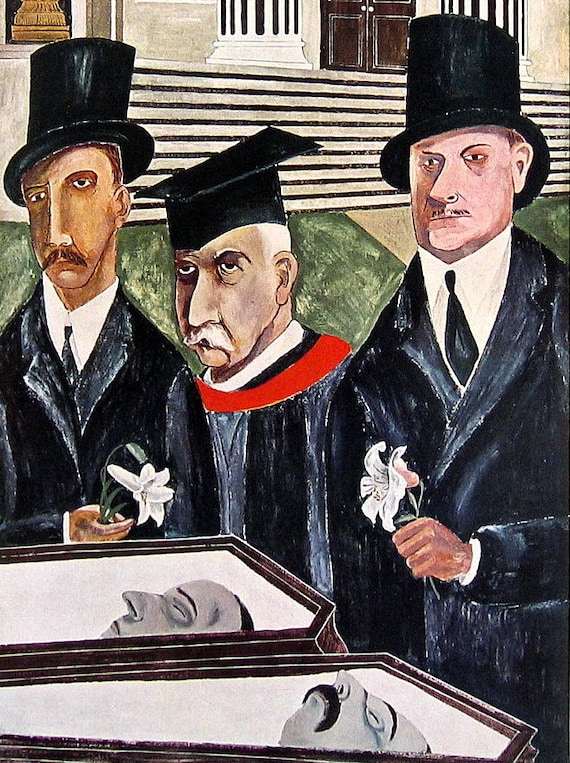
The Passion of Sacco and Vanzetti by Ben Shan


After serving one term in Congress, Rep. Vito Marcantonio was swept away in Franklin Delano Roosevelt's 1936 re-election king tide. 

Yet, even with powerful waves rolling Democratic, Marc's opponent Jimmy Lanzetta barely prevailed by a vote of 18,772, to 17,212. Marc would win the rematch two years later.
In “Vito Marcantonio: Radical in Congress,” Alan Schaffer posited that the freshman representative's downfall could be blamed, in part, on his rift with Luigi Antonini, leader of the powerful Italian Dressmakers Local 89, International Ladies' Garment Workers' Union.  

The one-time allies split, Schaffer asserted, when Marcantonio's efforts on behalf of the anti-fascist struggle in Italy led to increasingly constructive contacts with communists.  

The matter is open to dispute. Some say Marc could never have withstood the Roosevelt landslide, but in any case, his next move was to assume the presidency of the International Labor Defense (ILD).

In “Vito Marcantonio: Radical Politician,” 
Professor Gerald Meyer describes the ILD as brainchild of Joseph Brodsky, legal counsel to the Communist Party, to which the organization was tied.  

Marcantonio's defeat, Meyer wrote, influenced his decision to become president of the ILD.

Radical Defense

According to Meyer, it was a role in which Marc's congressional experience enhanced the outfit's infrastructure for influencing public policy. 

Marc's work with the ILD involved him in high-profile cases of the day, such as that of labor activist Tom Mooney, wrongly jailed for bombing a World War I “Preparation Day” parade in San Francisco. Marc joined the defense of West Coast longshoremens union rabble-rouser Harry Bridges, whom the government wanted to deport to Australia. He fought dictatorial Jersey City Mayor Frank Hague over union and civil rights alike.  

The ILD post, Meyer wrote, “catapulted Marcantonio into the position of national spokesman for the left and deepened his relationship with the Communist Party.”  

In 1937, as International Labor Defense chairman, Marcantonio penned the pamphlet, “Labor's Martyrs.” 

The document was published with an introduction by William Z. Foster, a prominent American communist: “The militant trade union movement of today,” Foster wrote, “heading towards a broad People's Front, is the direct lineal descendant of the great strike movement of the 1886 Chicago martyrs.” 

Foster is talking the "Popular Front" policy of international communists in the 1930s, which called for collaboration with other forces on the political left to combat surging fascism.

With “The Chicago Martyrs,” he is linking the policy to were those hung for the Haymarket Affair and it is with that historical event Marcantonio begins his discourse. The second part deals with the saga of Sacco and Vanzetti.  

Entitled “Labor's Martyr's,” labor, the organized kind, is the text's primary focus. 

Marcantonio suggests that organized labor is American as apple pie, is in the country's DNA: “Noble attempts to build [the labor movement] had been made in the days of our Revolutionary forefathers,” he writes.  

The Haymarket Martyrs
And Marc, a man who drew logistical support and droves of votes from the union rank-and-file, knew his syndicates. 

May Day Mayhem

He notes that Albert Parson, one of the Haymarket defendants [Marc prefers the term “victims”], “was a printer, a member of the powerful International Typographical Union which, even in those days, had over 60,000 members.”  

Membership counts are the currency of the union movement and source of their leverage in collective bargaining and street action alike. A consummate political operative, Marcantonio probably knew the rank-and-file tallies of the many unions blossoming across the country at the time.  

Applying color and pace, the phenom from East Harlem recounts the Haymarket debacle with a prose shaded by a sense of great grievance and a promise that labor's part in the fighting that has just begun.  

The text recalls the May Day strike of 1886. August Spies, a German metalworker and union organizer was invited to speak at the McCormick Reaper plant in Chicago. Police rushed the assembly with guns and clubs and scores were brutalized. A bomb was set off.

“Chicago papers were quick to point out that 'only' two had lost their lives!” Marcantonio's exclamation point underscores the purpose of this particular ILD production, which is to tie labor's contemporary battles to prior confrontations. To tell a longer, more emotional story.  

In “Labor's Martyrs” Marc is less the journalist and more the instigating pamphleteer. The text is a call to action rather than an academic or purely historical work. 

And it is a youthful work. Marcantonio died at the age of 51 and accomplished his many achievements as a young, brash and precocious force of life. He is just 35 years old at this point in his truncated, yet breathless career.  

Vanzetti and Sacco
Marcantonio writes that Spies rushed back to the German radical paper “Arbeiter-Zeitung,” which we highlight simply because he does not run from the word “radical” the way most American politicians did and still do. 

Authorities hung the bombing on eight anarchists making them a part of labor history in the process. 

“What the press made of it is one of the rawest frame-up trials in American history,” he writes, factually, vintage Marcantonio, who often resorted to expressions like “rawest” and “frame-up,” because of whom he chose to defend and the kind of battles he was obliged to fight. 

“The newspapers from coast to coast, our worthy 'New York Times' not excepted, howled for their blood, raved about an Anarchist plot to blow up Chicago, seize the government, murder, arson, pillage, rape – the whole program which William Randolph Hearst has made only too familiar to the American public.” 

Marcantonio had a special axe to grind when it came to Hearst, whose newspapers relentlessly attacked the congressman.

Gerald Meyer writes that Hearst's “Daily Mirror” described Marcantonio as a “political maggot” who “must feed on decay and corruption to survive.”  

Marcantonio continues: “The judge, Judge Gary, gave one of the most shameful performances that this country has ever seen, and it has seen plenty from its judges.”

Marc, that ambitious first generation son of Italian immigrants, loves America when it fulfills its promise, but his brand of patriotism does not preclude the telling of a true, people's history.  

That people's history he told had words of the following kind: “The bigoted speeches of the prosecutor Grinnell, and his aides, are equaled only by the speeches of the prosecution in the Mooney case, the Herndon case, the Scottsboro case. In other words, they established a fine precedent for all anti-labor prosecutions.”  

Marcantonio knows of what he speaks, because he served as an assistant U.S. attorney, a primarily prosecutorial post. He is writing on behalf of the International Labor Defense, a legal outfit, and as the lawyer chosen to spearhead its political efforts. 

Lawyered Up

The focus is legal, and his point is that “Labor's Martyrs” were created as much in courtrooms as in the streets or on the shop floor. There is more than a chronicle going on here. There is this larger question of labor's role at the crux of 1930s social change and revolution.  

After the Haymarket convictions, Marcantonio wrote, “Chicago papers collected a purse of $100,000 to divide among them as reward for work well done.”  

He doesn't offer any evidence. If Marc seeks a more just labor law, he is not beyond spinning a bit of labor lore in that effort. 

“And then came the appeal to the United States Supreme Court,” he forges ahead. “Old as they are, none of the present incumbents were then sitting on the bench. But their worthy forerunners were equally reactionary.”  

A keen sarcasm, laced with indignation, was a tool Marc used for slashing the arguments of opponents from the House Well, or the East Harlem street corner. It was not academic talk. It was a popular lexicon he could employ at will, without condescending, because it was his own organic idiom. 


“They did not die in vain,” he rallies. “Taught by the lessons of the Haymarket tragedy, such an organization as the International Labor Defense has been built by the workers and progressive people of America, to stand guard and prevent such legal murders today.”  

“Legal murders.”  

Marc as master of the subversive sobriquet.

Sacco and Vanzetti

Marcantonio Scribe then recalls, “two other labor martyrs who must be honored at the same time as the Haymarket heroes. The tenth anniversary of their death coincides with the fiftieth anniversary of the former in this year 1937.” 

Here he is writing of Nicola Sacco and Bartolomeo Vanzetti. Marc begins with a quotation from the latter.  

“I am suffering because I am a radical, and indeed I am a radical; I have suffered because I was an Italian, and indeed I am Italian; I have suffered more for my family and for my beloved than for myself; but I am so convinced to be right that you could execute me two times, and if I could be reborn two other times I would live again to do what I have done already.” 

It is a generous passage granted by the writer; gives voice to one unjustly silenced, in his own chosen words.

“To me these words are particularly poignant,” writes Marcantonio. “For I am an Italian, and proud to be of the same people that produced such a great spirit as Vanzetti, the descendant of Garibaldi, the forerunner of those heroic anti-fascist brothers who are today fighting Fascism and Mussolini in Italy and Spain.”  

Linked to the Struggle

Marc positions himself firmly along the historical leftist continuum; openly links himself to men executed for murder by the state. And he joins that tradition to the Italian spirit for the benefit of his constituents who were subject to a career-long history lesson from the settlement-house-teacher-cum-congressman.

Marcantonio writes of Sacco and Vanzetti, as workers and organizers.  

“Both found only hard knocks. Sacco was a shoe worker. Vanzetti had followed many trades after his arrival here in the summer of 1908. He worked in mines, mills, factories. Finally he landed in a cordage plant in Plymouth, Massachusetts. That was the last factory job he held. For here, as in all the others, he talked union and organization, and organized a successful strike. After that, he was blacklisted for good and had to make a living peddling fish to his Italian neighbors in the little town known as the cradle of liberty.”  

Marc sees, not just victims of legal murder, but heroes in their own right, beyond their victimization: “The tragedy of their untimely and cruel death is still an open wound in the hearts of many of us who remember them as shining spirits, as truly great men such as only the lowly of the earth can produce.”  

For Marc, this is the meaning of Sacco and Vanzetti.  

The Lowly of the Earth. These were Marcantonio's chosen constituency. His decision to join forces with the ILD rather than hang around Washington D.C., and peddle his influence in some lucrative fashion, says all that needs to be said about his motivations. 

With “Labor's Martyrs,” and his wider activities for the ILD, Marcantonio demonstrated how his electoral defeat in no wise diminished his fight for that constituency. Being a congressman was just one way to achieve the same ends.  

Marcantonio was not a career “politician,” so much as a dedicated advocate for the Lowly of the Earth.

"The Goodfather (A Novel): The Rising Fall of the Marvelous Marcantonio," can be found here: MARC LIVES!


Wednesday, March 23, 2016

Book Report: "This Coffin Has No Handles" by Thomas McGrath


Thomas McGrath.
With a title like "This Coffin Has No Handles: A Novel" you can't help but know what you're in for.

Thomas McGrath's depiction of working class, west side Manhattan in the days immediately after World War II is told in a noir style not uncommon to mid-century American literature.

Its tone is tense and grim, the prose dense, the plot thin.

There is a labor action going on -- the 1945 longshoreman's strike -- but the real conflict takes place inside McGrath's scattershot collection of characters. None of whom are particularly happy, settled, or comfortable in their own skins.

It is a rare book that understands or properly depicts the crosscurrents of lethargy and hyperactivity that characterize an industrial strike (one provokes authority and then takes a metaphorical seat on their ass).

McGrath's tome is passport to a time when American cities were home to factory workers and wharf rats. Where people lived stacked atop one another in crowded warrens shot-through with the smell of someone else's cooking and a soundtrack of babies crying and married couples fighting.

McGrath's characters are desperate, caught in dead-end alleyways with thugs, "metal gleaming in their hands," blocking the escape route.

Blackie Carmody must choose between joining the rackets in order to pay for his mother's cancer treatment, or take the work-a-day job he knows will make the woman happy while sealing her fate.

McGrath's cast is led by one Joe Hunter, a card-carrying Communist Party member just back from a turn in the European theater with the U.S. Army.

The other characters revolve around him in greater and lesser arcs, although sometimes the author follows a different tortured soul on their individual rounds for a bit.

There is a crooked union leader. There are rank-and-file strikers, each standing in for the various degrees of commitment typically found in such industrial battles. There is misbegotten hitman and a teenage girl growing up too quick.

Tremendous, if petty, violence and racketeering abound. There is a grim, philosophical striving from some of the players in this tale and directionless ennui from others.

The Communists are the good guys, incorruptible, committed, diligent as an army of ants in their well-organized and underfunded effort to secure worldwide justice for the working stiff through countless shop-floor scuffles.

The positive portrayal landed McGrath before the House UnAmerican Activities Committee, where an unhelpful turn as witness cost him his job as professor at Los Angeles State University.

The point being, you have to understand where the poet was coming from.

In "Manhattan '45,"Janet Morris opens with ebullient soldiers returning triumphant from World War II to a New York City at the height of its power and prestige.

Her New York shimmers with possibility and prosperity, McGrath's "iron city" is a decidedly darker place:

"Black cliffs rising into the dark sky to the south were expensive hotels. They were hung with ladders of light and were crowned with the aureole of luminous mist. To Hunter they looked as if they were enormous chunks of black ice, rotted loose from the bottom of some great ice island, rising slowly from the depths of a cold midnight sea hung with chains of freezing phosphorescent light."

McGrath, who died in 1990, was a fine writer and the book maintains a nice tension that succeeds in pulling one through the thicket of ruminations that, at times, veer off into authorial exposition.

This is especially true at the end where this poet's sharp and complex mind draws a portfolio's-worth of conclusions from the strike's outcome.

For the Big Apple buff, students of unionism, and scholars of the American city, this "political noir" serves of plenty of good "Red" meat.

"The Goodfather (A Novel): The Rising Fall of the Marvelous Marcantonio," can be purchased at: MARC LIVES!

Saturday, May 30, 2015

The American Labor Party Considered at the Mulberry Street Public Library


Was the American Labor Party the most consequential third party in U.S. politics during the 1930s and '40s, or perhaps the entire 20th century?

Gerald Meyer, author of “Vito Marcantonio: Radical Politician,” took to the Mulberry Street Library podium May 9, and gave airing to these issues while mapping out the American Labor Party's (ALP) history and trajectory.

Meyer said that without the American Labor Party, New York City would have been denied the unique social-democratic configuration it acquired under Mayor Fiorello La Guardia, and the left, a true national spokesperson during the 1930s and 1940s in Marcantonio.

With La Guardia and Marcantonio both having run on the Republican ticket, their leftward lurch in the late 1930s meant they needed a place to hang their ideological hats, The ALP provided the rack.

In 1937, La Guardia had to run for a second term. “And this becomes critical,” noted Meyer, “because there had been reform mayors before in New York City, but they never would win the second time. They would become mayors and start to clean up New York City, the corruption and the cheating at the ballot, and forget to take care of the poor.

“In the next election... back would come Tammany Hall, over and over again.”

In his first winning campaign for mayor, La Guardia ran as a Republican, but did so with the backing of the Fusion Party, which between 1933 and 1937 had been hollowed out.

“So how is he going to win an election running as a Republican in 1937 in New York City? Well, it's the American Labor Party,” said Meyer.

La Guardia prevailed. The ALP's participation in the election, said Meyer, was “priceless,” representing 36 percent of The Major's total vote haul. When he ran for a third term as mayor in1941, the Little Flower got exactly the same percentage of votes from the American Labor Party as four years earlier.

Meyer asserted that the votes enabling La Guardia to win handily came from the ALP.

“Here we are talking about something big,” Meyer stated. “This is a big deal. What you have now is the mayor of New York City – keeping in mind the importance of New York – creating a social-democratic metropolis. That's what occurred in New York. A city orchestra. Who ever heard of such a thing? I mean who needs socialism when you have La Guardia?

“Everything was happening. All kinds of housing projects, wonderfully designed, with a thoughtfulness about how they would be situated to maximize the amount of light coming in. La Guardia said, 'I want to make people happy.' A lot of us didn't even have parents that wanted to make us happy.”


Gerald Meyer at Mulberry Street Library
Stated Meyer: “There is no other American mayor in any city, at any time, that has the record and background of La Guardia. He was a treasure and great hero.” The American Labor Party's triumph with La Guardia in '37 meant Marcantonio no longer had to campaign as a Republican, or just as a Republican. He ran on the ALP line and garnered a resounding return to Congress in 1939. To the mass organizations of the left, Marcantonio became a hero who spoke at their conventions and gave voice to their concerns in the House of Representatives.
“And they would become enrolled members in the American Labor Party,” said Meyer. “What a good beginning.”

The ALP arose, in 1936, around a very specific goal: the election of Franklin Delano Roosevelt. Meyer suggested that, upon his ascendance to the presidency, it was not suspected that FDR would enact such a radical, leftist program.

Roosevelt, Meyer said, knew he needed New York to be reelected and, consequently, showered the Depression-era city with federal largesse, making it the 49th entity for the Works Progress Administration (WPA) in addition to those established for each of the 48 states.

New York City, said Meyer, received something like one-fourth of all WPA monies allocated nationwide.

“Hundreds of playgrounds were built, all the swimming pools still being used, the public libraries, public schools, Brooklyn College campus, Queens College campus, the Triboro Bridge, the IND (Independent Subway System) subway, the list is just endless,” said Meyer.

“By 1936, progressives of all sorts really understood that the need for reelecting Roosevelt was overwhelming. New York was critical, because at the time, it had 47 electoral votes (today it has 26).”

Standing in Roosevelt's way was the socialist vote in New York City. Meyer said there was a large base of Jewish working-class people for whom socialism was a kind of secular religion that had replaced the old one they left behind in Eastern Europe.

In New York, the Socialist Party had achieved vote tallies as high as 300,000 and this had the Roosevelt coalition worried.

“So the ALP, in a very specific way, was intended to win over this voting block for Roosevelt. It was just that specific,” Meyer emphasized. “But as soon as the ALP began, as soon as a word was spoken, there was an absolute flood of interest.”
Professor Meyer suggested the party's name had something to do with its early success.

“Names are very important,” he said. “American Labor Party. To have the word 'Labor,' in the name and to suggest there is a party that is now going to exist, explicitly representing the working class, is a tremendous phenomenon.”

The ALP had the support of a union movement in ascendance, access to a constituency and the means of activating them, means to educate them through union newspapers, and the resources to provide staff and money in a consistent way, not just for three months, but for 20 years, said Meyer.

“So the party was really based on top of this tremendous infrastructure of union and labor organizations,” he observed

The American Labor Party was able to provide the organization and ideological outlook, with a connection to unions, which ensured the Roosevelt would win the nomination and the election.

The key to the ALP's political power was its base in New York, said Meyer. “This is not happenstance really, the tremendous number of electoral votes, New York being the media capital, the intellectual center of the U.S., the response to the ALP was just enormous.”

The American Labor Party mobilized all its resources to reelect its congressman from New York, Marcantonio. It was the top priority and established the East Harlemite as a national spokesperson for the American left through the 1930s and 1940s.

Said Meyer: “Marcantonio, in seven terms as congressman between 1934 and 1950, in no uncertain terms, gave us what we never had again, a national spokesperson. He articulated brilliantly, eloquently and consistently over the entire spectrum of issues... agricultural policy; there are no farms in East Harlem, none.

“I don't know that if he had come from Minneapolis it would have occurred and this makes the ALP incredibly important,” said Meyer.

But the legal mechanics of voting and sharp organizational skills both played significant roles in the American Labor Party's rise.

The ALP is a state party, he explained. The U.S. Constitution designates the organization of elections to the states, which means different laws in different states.

The oddity of “fusion,” or cross-endorsements of the same candidate by different parties, makes it easier to field third party candidates in New York State than it is elsewhere.

“This is what we have to think about with the ALP,” said the Hostos Community College Professor Emeritus. “It is allowed to appear in New York in ways that it would be very difficult to do anywhere else.”

The Democratic Party's declining status among certain groups voters helped, too. In New York, the reality was one of a political machine run by Irish-American politicians, much the same as the Catholic Church in the Empire State.

The Democratic Party was in favor of the New Deal social program, unions, social security and redistribution, but simultaneously, Meyer noted, it was extremely anti-communist, which very often turned into anti-semitism.

“This has repercussions,” Meyer said, “because the other groups that are left out become resentful.”

“And this meant the Democratic Party was not viable in relation to what was happening with the New Deal, because the program was moving further left and appeared to be, and I believe was, highly socialistic. And that was not convenient for anyone in the New Deal to say, nor anybody on the left to say.”

The ALP exploited this breach, and leveraged the power it drew from it “brilliantly,” according to Meyer. The party saw who the underrepresented groups were: African-Americans; Puerto Ricans; Italian Americans, and then fielded candidates to meet those constituencies where they lived.

All of this was done through the new city charter, Meyer observed, a document crucial to the American Labor Party in the boroughs because of its proportional representation provisions in city council elections.

“Proportional representation in New York City is something you need to know about and study and see why we have to integrate electoral reform into our own political work. Without it we are not going to go very far,” said Meyer.

Winner-take-all-elections put the electorate in an impossible quandary, because in voting for the candidate a person likes best, one often contributes to getting the candidate they like least.

“People will do it once, they might do it twice, but that's it,” said Meyer. “And so the two major parties have hegemony indefinitely.”

With proportional representation, the representation in an elected body is based on the proportion of votes for a party so that a vote for the party of your choice therefore doesn't contribute or detract from the part you like next best.

In the first city council election the American Labor Party contested, it received approximately seven seats. With 30 percent of vote in Bronx, it got 30 percent of the council seats from there.

In the city council elections of 1943, one-in-four voters in New York City went either for the ALP or Communist Party, he said.

“The reason we don't have a left is that we are strangled by a system that makes a left impossible,” said Meyer. “We go around doing pageantry, but can't have any consequence.”

It was just how consequential the ALP was that garners Meyer's enthusiasm: “Getting La Guardia elected, allowing Marcantonio to get reelected and then to six more terms. Without the ALP it would not have been possible. We wouldn't have had a national spokesperson. We wouldn't have had a social-democratic metropolis.”

This kind of success within the context of a third party in American politics requires some seasoning, Meyer asserted.

“You don't roll out of bed and know this stuff. There has to be strategy and somebody with a wider view that coordinates matters, so things wind up. It's very hard to win anything, because the right controls the economy, and they control the media, and they're vicious on top of it.”

He recounted how Adam Clayton-Powell received the ALP's designation for a city council seat from Harlem. “This meant either the Democrats gave him the endorsement or there would have been an American Labor Party city councilperson,” Meyer noted.

The same thing happened when Clayton-Powell ran for Congress. “In both cases, the first African-American city councilperson in New York City and the first African-American congressman in New York State, are the doing of the ALP," said Meyer. 

“The American Labor Party did that by knowing the system. It's one of the reasons Marcantonio was so effective. He knew parliamentary procedure,” he noted. 

The American Labor Party was never repeated anywhere else, Meyer noted. Its history indicates that it is possible to resist the assault on all progressive gains that have been made.

“Based on what we know is actual reality we can create a vision where we can produce entities that would be repositories of power for the people,” Meyer concluded, “and be able to move things forward so that we can start winning very big.”

Amazon.com: The Goodfather: The Rising Fall of the Marvelous Marcantonio