Wednesday, February 12, 2014

Leonard Covello


The Vito Marcantonio Forum (VMF) is having a book party, dramatic reading and discussion of Leonard Covello's "The Heart is The Teacher on February 22 (2014) at the Mulberry Street Branch of the New York Public Library.

The occasion is a reissuing of the book by the John D. Calandra Institute. 

Professor Gerald Meyer wrote the afterword and will speak on the reform educator's pedagogical relevance in today's multi-cultural society.

LuLu LoLo will dramatize passages from the book. Roberto Ragone will "take on Vito Marcantonio's perspective as the seven-time elected congressman from East Harlem was a close friend to Covello," according to a VMF flyer for the event.  

The branch library is located at 10 Jersey Street, corner of Mulberry and Prince streets. The event will begin at 2 p.m. and run approximately two hours.

Below are reviews of the "The Heart is the Teacher" and "Leonard Covello and the Making of Benjamin Franklin High School."


"The Heart is the Teacherreads as clear-headed and purposeful as the man it describes.

Its string of anecdotes are rendered in a straight-ahead, clean prose, chronologically scripted from educator Leonard Covello's earliest days in the Italian village of Avigliano, to his retirement from the New York City school system.

It is a narrative which deals only in the essential and does the good job of conveying his ideas.

"The Heart," does a marvelous mapping of the disconnect endured by those who left pre-industrial, rural Italy to settle in urban ghettoes like Manhattan's Lower East Side or East Harlem.

There is much pathos in Covello's story. His mother expired from depression born of that chasm between old world and new, which she could not find it in herself to bridge. "Cara Mamma!" he cries
to the reader when recounting her departure.

Similarly, his first love died in the opening phases of their well-suited marriage.

And, of course, as an educator, he bore certain students' failures as fully as he permitted the success of others to fill his sails with wind.

The early chapters fully divulge the difficulties of the Italian-American experience: the gulf between foreign-born parents and their United States-born children; the gap between success Italian-style, via family loyalty, and the American promise of independent self-realization.

And "The Heart..." is also a possible prescription for a particular kind of American success. Covello did not become a wealthy industrialist, but his academic commitment, first as a student and later as teacher, carved out a significant niche as intellectual and policy wonk.

Himself the subject of certain books on education, Covello's approach was hardly rocket science. Socialist of bent, his approach to kids was strictly old school:

"A child," he wrote, "cannot be left to his own devices. He must have discipline, must be given responsibilities. He is a part of the family and the community and must be made to feel from the beginning that he has a duty toward that family and that community."

The start of World War II stunted his efforts at making Benjamin Franklin High School an engine for change in the surrounding East Harlem neighborhood. It convinced him that such violence, however far away, fed his young charges with the same unfortunate inclinations.

Covello's autobiography is terribly understated so that it suffers somewhat from a lack of drama, although his life was hardly devoid of it. But through the narrative's calmness, the reader may be sensing the affect the educator had on those he spent his life trying to help.

"Leonard Covello and the Making of Benjamin Franklin High School: Education As If Citizenship Mattered" dissects American society's move away from the public commons and towards the individualistic principles and private sphere championed in the conservative canon, through the experience of one man at one New York City high school. The authors Michael Johanek and John Puckett recap their effort with the closing question: "How does Covello's theory and practice of community school speak meaningfully to the problem of American's hastening retreat from the public sphere?"

"Leonard Covello and the Making of Benjamin Franklin High School" is a tough academic slog covering the first days of the community school movement, as envisioned by the education theorist John Dewey, and the way it dovetailed with the early 20th Century reform movement in the United States.

It discusses, in adequate detail, certain preliminary thrusts at integrating a school's efforts into the goals of the surrounding community, and their varying degrees of success.

But mostly, and as the title suggests, the book returns to Leonard Covello, an Italian immigrant convinced of education's value to any newcomer's development, and his efforts at applying community school principles in the well-defined terminus of East Harlem, New York City.

The book demonstrates the verity of Emerson's platitude that, "An institution is the shadow of one man," by tracing Covello's efforts at opening a school for the underserved area, teaching Italian to the children of immigrants from Italy, and grooming enough students to generate at least one formidable star - Vito Marcantonio.

Marcantonio gave Covello the nickname by which two generations of high school boys would come to know him - "Pop."


More importantly, he helped his old mentor construct a new public high school on the banks of the East River, secured countless employees from the Depression-era Works Progress Administration to staff it, and stood guard when the experiment came in for conservative attacks.

The meat of the book covers the very specific work Covello and his team did implicating Franklin into the troubled neighborhood's affairs.

These included a sociological mapping of immigrant focal points, exhaustive surveys of area businesses, clean-up campaigns, storefront community centers, communal gardens, parades, dances, and conferences on racial tolerance crucial in a neighborhood where Italians, Puerto Ricans, Blacks, and slivers of other groups cohabitated uneasily.

The book makes clear that putting these ideas in play turned out to be a lot harder in practice than they were to write about in theory.

There is admiration for Covello and his dream, but no whitewashing of his shortcomings nor the fact that the Franklin experiment was largely over even before he retired in 1956.

There is fair analysis of the political winds buffeting attempts at improving East Harlem through the direction of a scholastic hub.

As the progressive '30s gave way to the World War, the ensuing conservative era, and Marcantonio's unseating in Congress, the very idea of "community school" carried the unpopular baggage of socialism and Covello's wings were clipped accordingly.

Finally, the authors draw conclusions about how the failure speaks to education in America today and suggest the circumstances of Covello's time prevailed over principles which were not only sound, but of enduring value.

Wednesday, January 29, 2014

Vito Marcantonio and Pete Seeger: Allies Through Art

A Young Pete Seeger.
Marcantonio is the best,
but I wouldn't give a nickel
for all the rest
all the rest
all the rest
I wouldn't give a nickel for
all the rest

Washington Breakdown” Pete Seeger

Pete Seeger's long life and death remind us that the progressive vision of Rep. Vito Marcantonio – one of a caring and generous government financed by taxes on our wealthiest individuals and corporations – was not formed in some too-distant time of black-and-white images filled with men wearing suits and fedoras.

It was just yesterday, or at least the day before (Seeger was 94).

The man who sang at President Barack Obama's first inauguration in 2008, was singing for Marcantonio back in the 1940s, and singing about him as well.

The verse at top is culled from an Almanac Singers track entitled, “Washington Breakdown,” (listen here) which is sung solo by a banjo-slinging Seeger.

It's an anti-war song, anti-World War II. At the time of its recording, the American left, led by Marcantonio, was dead-set against getting into another massacre like the one that had occurred in Europe two decades earlier.

Franklin D. Listen to me
You ain't gonna send me across the sea.
'Cross the sea, 'cross the sea
you ain't gonna send me
across the sea

That would change once Hitler attacked the Soviet Union and broke the nonaggression pact between them. Marcantonio did an oft-criticized about-face and became instrumental in passing legislation organizing and directing efforts in the House of Representatives to thwart fascism.

Seeger and the musical combos he worked with such as the aforementioned Almanac Singers, or The Weavers, did not waiver in their activism once the war was over.

Seeger himself was only a short way along a path pocked with political activism and marvelous songs to sell it.

In “Reflections: Seeger and Me,” Pulitzer Prize-winning journalist Saul Friedman recalled:

And in 1948, when we were still in mourning for Franklin Roosevelt and charging Truman with encouraging a cold war, even my apolitical mother got political, taking me to Philadelphia to the Progressive Party convention that nominated former vice president Henry Wallace for president.

That's when I got involved campaigning for the first time and my efforts included Wallace and the incumbent, left-wing congressman from upper Manhattan, Vito Marcantonio, who won his seat as a Republican and switched to the American Labor Party (ALP). And it was during one of the rallies for Marcantonio on the streets of East Harlem that I sang on the back of a flatbed truck with Seeger and others, although I do not remember the songs.”

The relationship was more than a passing one, for Seeger's engagement with the radical congressman would "Marc" him for life.
"The Weavers" sing at a Marcantonio event.

One year later, the successful brand of street corner, retail politics Marcantonio and the ALP excelled at would change the course of Seeger's career. Boutique marketing did not a congressman elect.

In his biography, “How Can I Keep from Singing? The Ballad of Pete Seeger,” David King Dunaway recounts...

Another incident motivated Seeger, one he later spoke of as a crossroads in his life. One afternoon in 1949, Irwin Silber had been called by the left-wing ALP, who wanted to set up a benefit concert with Richard Dyer-Bennett – a singer of traditional ballots.

Perhaps I can help you get him,” Irwin had answered. “But in case he can't make it, how about Pete doing the concert?”

Oh we know Pete,” the caller from the ALP had replied. “He's sung on our sound truck for years. We need someone who can bring a mass audience. We need to raise money.”

On hearing this, Seeger got really angry. He remembered long winter nights when he had sung outside for the ALP: “Here I was, trying to follow what I thought was a tactical, strategic course, and yet Dick Dyer-Bennett – who was making a career in a traditional fashion – was of more use than me.

That taught me something.”

It was a story he'd tell hundreds of times. For years he had avoided commercial bookings, content with local, progressive audiences. "If it takes a 'name' to bring in a large crowd," Seeger figured, "that's what I'll have."
For Seeger, the lesson was clear.

I decided to stop congratulating myself on not going commercial."

Easier said than done. Dunaway writes:

Trying their talent in the marketplace tempted Ronnie and Fred; furthermore, Seeger's point about political isolation was brutally driven home when The Weavers did campaign for an ALP candidate, Vito Marcantonio (probably the closest the Communist Party had in Congress). They went out on an open sound truck. Gordon Friesen from Almanac days ran the affair well, but the crowds didn't respond. The Weavers sang their left-wing repertoire and songs made up for the occasion. From a nearby window, tomatoes started splottering the unprotected truck. Seeger looked up anxiously: “What do we do now?”

Be glad they're not bricks,” Gordon answered with a grim smile.

Contained in the Marcantonio Papers collection housed at the main branch of the New York Public Library, is a 1949 radio commercial for Marcantonio's mayoral bid.

In those days, brevity, flash edits, and product or personal acronyms were not the standard
selling techniques they are today.

The spot runs about five minutes and features a guitar-playing folky more or less rapping the praises of East Harlem's San Vito.

Step over, step over, step up everybody
I want you to meet a man I know
candidate for Congress
Vito Marcantonio!

Documentation accompanying the cassette recording does not identify the performer, but any review of the existing literature at least, would suggest it is Seeger or one of what John Sayles termed his “hootenanny” cohorts, such as Fred Hellerman.

In a 1949 piece published in “Harper's” magazine, Richard Rovere wrote:

"When he mingles with the Bohemian intellectuals who are his friends, [Marcantonio] looks like an earnest young law student wearied by hours over Blackstone, but eager nonetheless for every word that is said. In ordinary conversation he talks in the reasonably clear and precise accents of a New Yorker who has tried to cultivate a good speaking voice."

Marcantonio biographer Gerald Meyer suggests the congressman was more apt to be playing cards with neighborhood pals in any of East Harlem's countless social clubs than whooping it up with the jazz crowd in some uptown viper room.

Fair enough, though Marcantonio did have alliances in the demimonde. Writer Howard Fast was a friend and collaborator. Dashiell Hammett chaired his mayoral campaign fundraising committee. He cosigned petitions with Dorothy Parker, took bear hugs from Paul Robeson and associated with Puerto Rican poet Clemente Soto Velez.

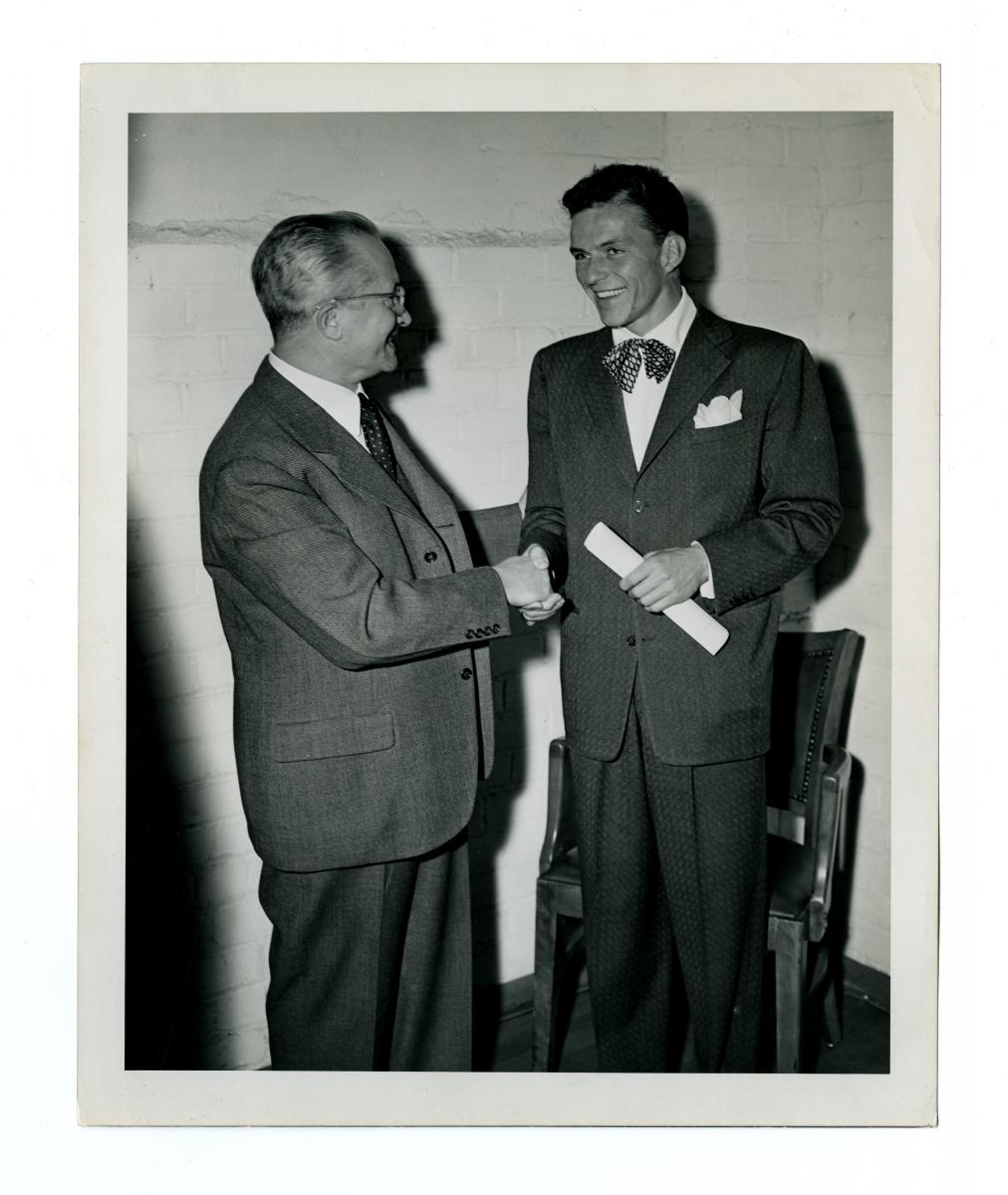
Marc was hip enough to call on Frank Sinatra to sing when tensions between blacks and Italians heightened at Benjamin Franklin High School.

Marcantonio may have been a homeboy who never left the streets he was raised on and departed the country just once, but he was also a New Yorker, a Manhattanite and cosmopolite and it is through the story of Pete Seeger's life that we can conjure the profile of a congressman attuned to the popular culture of his time.

Wednesday, January 22, 2014

"Vito Marcantonio: Radical Politician" by Gerald Meyer


Ralph Waldo Emerson said an institution is the shadow of a single man, a lesson Gerald Meyer learned during research on the history of the American Labor Party (ALP).

In his "Acknowledgements" to the book under consideration here, Meyer confesses, "In the process of accomplishing this formidable task, I fell in love with Vito Marcantonio. The ALP was an important institution, but Marcantonio loomed over it."

"Vito Marcantonio: Radical Politician, 1902-1954"represents the skillful and thorough response to a series of questions posed by Herbert Gutman, the sponsor of Meyer's proposed doctoral dissertation: "Who voted for him? Why did they vote for him? What was East Harlem like? What did people do for a living? Who owned the stores?"

Meyer's work succeeded two earlier efforts, "Vito Marcantonio: Radical in Congress," by Alan Schaffer and "Vito Marcantonio, The People's Politician," by Salvatore John LaGumina.

Schaffer's effort placed Marcantonio in the national firmament of the times, 1902 to 1952, and LaGumina added some anecdotal history and a slightly different angle than that of his predecessor.

But it is Meyer's book that places Marcantonio in the New York of his day and, specifically, the East Harlem neighborhood that produced him.

Gerald Meyer
Here is Marcantonio diving off a truck into the street mob during a speech, arms flailing. There the Congressman confessing unconditional trust in his grandmother who attends rallies with an umbrella under her coat in the event of fisticuffs.

And here is the "retail" congressman delivering coal and Christmas baskets to troubled neighbors, a guy who empties his pockets to the hard luck cases that pock his district.

Meyer's work goes where the other two did not in regards to the Marcantonio Papers archived at the New York Public Library on 42 St. and Fifth Avenue.

In these 85 boxes can be found dusty, flaky records of "Marc's" public life and work, but more importantly, the voices of his constituency, which Meyer has culled for insightful passages from letters both handwritten and typed.

Yes, Meyer meticulously details the complicated nature of New York City's "fusion" politics and the skill with which Marcantonio navigated them to unique projection as a national leader of far left-wing forces.

But the author also renders the radical politician's story an organic whole.
Rather than the narrative of some anomalous oddity out of time, we have in this book a man fleshed out and brought to life by the environment that produced him and to which he gave so much form, through his leadership.

In his conclusion, Meyer laments Marcantonio's slow fade into anonymity and argues that, "his story deserves to be known, because it contradicts so many of the platitudes which pass for American history and therefore suggests new ways of thinking about the present."

"Radical Politician" takes the first, bold steps in this effort, loyally transcribing the voices of desperate constituents seeking assistance of every kind and often beyond the natural purview of the congressional representative.

Meyer began his project just in time to provide his work with an important layer of oral history extracted from residents of East Harlem, now mostly departed.

Through these voices we gain the story of progressive and communist movements during the 1920s, '30s, and '40s and begin affixing them to real faces; faces worn with lines wrought by terrible struggles.

And through these same voices, we hear Marcantonio's, because they were one and the same.

Thanks to Meyer's rendering of the fighting congressman and his world, we realize that, beneath the Jazz Age's glamorous narration, people were being crushed by the inequities in American life.

We witness how the annihilation accelerated with the next decade's economic miseries so that these movements appear not so much as insidious viruses inexplicably invading the body politic, rather as natural responses to a clamor for redemption.

And through Marcantonio's story, we can see how the ensuing repression was not the result of some lightning-strike catharsis which brought Americans to their senses, but the product of a brutal rollback to darkness fueled by American capital's resurgence after the healthy profit-making venture that was World War II.

"Radical Politician" renders a multifaceted talent: a lawyer, political street fighter, parliamentarian, neighborhood Don, leftist commissar.

A man who had affairs, yet was sainted by those who knew and were affected by his labors, a man who switched tacks to accommodate the shifting sands of mid-century politics, and committed enough mistakes to make him more human and beautiful than so many that populate our historical memory.

Tuesday, December 3, 2013

Where's Marc in Literature? Michael Parenti Responds


Michael Parenti's “Waiting for Yesterday: Pages from a Street Kid's Life,” is a spicy, cantankerous, yet humorous, memoir of life in East Harlem's Little Italy when it was still Little Italy.

The well-known intellectual writes about local characters, the traditions of Italians and Italian-Americans alike (there's a difference, you know), while managing to comment on national and world affairs, culture, politics and all points in between.


Despite its information-packed brevity, Parenti made the rare space in modern literature for Congressman Vito Marcantonio, in his thirty-second chapter entitled, “Someone Else To Remember.”


He observes that, in addition to taking the most radical stances in the defense of unions, minorities, public ownership or world peace, Marcantonio, “could also be judged by the enemies he made: the moneyed interests, big landlords, corporations, fascists, militarists, imperialists, and the reactionary witch-hunters.”


The primary entry in Parenti's recuperation of The Marc involves a campaign event on the “Lucky Corner” at 116th Street and Lexington Avenue.


There, some 500 Italians and their locally bred offspring had gathered to hear Marcantonio speak when, in the middle of his address, there came a ruckus from down Lexington:

“A caravan of cars – shooting sparklers, flashing bright lights, blasting melodious horns and wild music, and sending balloons aloft – came rolling up Lexington Avenue from Spanish Harlem right alongside the large crowd gathered on 116th Street. It was a Puerto Rican invasion!”


Michael Parenti

Parenti duly notes that there was no love lost between the earlier settled Italian community and the newly arrived Puerto Ricans. The Italians, he explains, viewed the latecomers as competition for jobs, apartments, schools, you name it.

“Now here they were, those wild Puerto Ricans rolling a blazing cavalcade right in the middle of Marc's talk and into the middle of Italian Harlem. Would he react with fury at the interruption? No, he flashed them a big smile, waived vigorously, and shouted an extended rousing welcome in Spanish. By now it was obvious that the invasion from Spanish Harlem was a friendly one. These were Marc's supporters and he had been expecting them all along.


“What happened next was something I shall never forget. As if of one mind, the large crowd of Italian-American men all turned toward the caravan rolling up Lexington Avenue and broke into thunderous applause and deep-throated cheers. At that moment we realized that the Puerto Ricans were not our competitors; they were our allies. (In addition, we probably were impressed and proud that Marc could marshal such enthusiastic support from Spanish Harlem).

“Many politicians divide the common people against each other,” Parenti continues.
“Marcantonio brought them together, showing them their mutual interests – which is one of the reasons he was so hated by the powers that be.”

Parenti dedicates a paragraph to The Marc's effort on behalf of his Puerto Rican constituents.


“People loved Marc because he meant it,” he writes. “He also lived it. He worked tirelessly building an effective organization that was both a political machine and a social service agency.”


At the congressman's funeral, Parenti chatted with a “saddened African-American woman,” who declared Marc both an inspiration and generator of “clarity.”


“Vito Marcantonio goes unnoticed in the official political history of this nation," he concludes. "But he was loved and mourned by hundreds of thousands. For some of us he remains unmatched.”


Like Parenti, The
Vito Marcantonio Forum is committed to correcting the historical record, which oft-times has ignored or misrepresented Marcantonio's unceasing work on behalf of those left out of the American Dream and his courageous fight for a more authentically democratic country.


"The Goodfather (A Novel): The Rising Fall of the Marvelous Marcantonio," can be purchased here: MARC LIVES!

Friday, November 22, 2013

"A Blanquito En El Barrio," Gil Fagiani's East Harlem


"A Blanquito in El Barrio" is a parade of fringe urban characters tinged in tropical light (under soot), a borinquen carnival, sexy sometimes, baroque others, festive or nightmarish.

This collection of poems from 1966 through 1969 offers a view of Puerto Rican culture in East Harlem by a white guy (blanquito) from Connecticut, a survey of sixties New York and the drug scene that characterized it, as well as impressions of immigrant life, settled Nuyorica.

The clash of cultures spins sparks over most every page, as in “Reunion,” where an announcement in the doorway that “We are Catholics” contrasts starkly with the commission of adultery beyond its threshold.


The style in “Blanquito” is plainspoken, almost prosodic. There is little that is opaque or requiring contortions of linguistic comprehension. Sometimes this works in poetry, sometimes it doesn't. Here it does, the sparing, but forward-driving narrative possesses the preciousness of verse.


In “Fluteflirting,” the bond between music and sensuality coheres into erotica, without ever employing a hardcore vocabulary:


“He trills at the end of an arpeggio.
Her shoulders shake, nipples harden.

“He flutter-tongues high G.

Her legs tremble, eyes closed.”

The scene between dancer and flautist is literally choreographed through typography, the poet playing at puppeteer. The result is simple and on point, but open-ended rather than pat.

Riffing.

For all his clean lines, sometimes, like a musician who has kept with the beat too long, Fagiani breaks out in a redolent riff, as in “125th St.” where:

“...girls in straw hats wave at me
with mocha tans
and strawberry fingertips."

Music is very important to “Blanquito,” which generates its own and commemorates much of what was heard on El Barrio's streets in those times. It even comes with a discography, the names of bands and song titles themselves a kind of found art: “Soul Makossa,” Manu Dibango. “Boogaloo Blues,” Johnny Colón...


Not that Fagiani's is a candy-striped, timbale-splashed El Barrio. In “Blanquito,” The Spanish Harlem of the time is rendered in an earthy pallet, bruises and all, without repugnance or even detachment, rather with an intimation that what is ugly is also part of the beauty of the whole.


Fagiani is a founding member of the
Vito Marcantonio Forum and “A Blanquito in El Barrio” is dedicated to the unjustly forgotten East Harlem congressman.

Litany of San Vito.

San Vito of East Harlem             Pray f
or us

San Vito bread of the poor          Pray for us
San Vito crucified by Wall Street   Pray for us
San Vito Martyr of McCarthyism      Pray for us

From the jail cell walls           San Vito deliver us

From the backyard crap game        San Vito deliver us
From the loan shark's vig          San Vito deliver us
From the drunken stupor            San Vito deliver us
From TB and asthma                 San Vito protect us
From the social worker's visit     San Vito protect us
From the immigration raids         San Vito protect us
From the landlord's greed          San Vito protect us”

Read on its own, the piece's rhythm links the people of El Barrio and their congressman, the kindness he showed them, his secular sanctification and their mutual victimization by the same unforgiving forces.


Seen as part of a larger canvas, the poem serves as a kind of reprise, linking Vito Marcantonio to characters come before in “Blanquito.


In “Cuchifrito,” the blanquito finds himself turned on by the salacious way a puertoriqueña he's casing slurps her greasy native treats.


“La Capitana” recounts a childhood social worker hauling her innocent charges to confront the bureaucrats who have cut their summer program funding.


“First Day in El Barrio” has an Italian cop born there, before it went Puerto Rican, mocking the blanquito and his crusading friends for being heavy on book learning and short on street smarts.


“when he began his barrio beat

he was young and idealistic too
and wanted to help people.
But in no time he learned
that except for a few residents
too scared to say a word
mostly he met backstabbers,
sneaks, junkies, welfare bums,
dope addicts and cutthroats.”

Dust Recuperated.

“La Loca,” depicts a straight-playing secretary and mother of three who gets her freak on by hitting some weed and dancing for multiple macho admirers at something called the Hunts Point Plaza.


And there are numerous junkies laying about the streets and alleys of Gil Fagiani's East Harlem, notable among them the “Fashionista” whose journey on junk takes him from dandy to dirtbag.


“Blanquito” dives into an unknown or, worse, ignored world, recuperates the lives of humans treated as something less than human. Without it, the junkies and petty thieves and desperate but honest ones who pass anonymously and without imprint on the collective memory, would be dust.

Gil Fagiani
Much the same can be said for Marcantonio whose life's work was to improve their situation.

The book introduces us to the jail cell walls, the backyard crap game, to the druggy stupors so that, by the time San Vito makes his appearance, these are not single-shot sentences, but markers for full-blown characters.


The yarns in “Blanquito” are
woven from ecstatic party vibe, lowdown hangovers or overdoses, stories of people who try hard getting the same raw deal as those who don't do. There is fried food, swampy summers streets with the sewer smell rising up, the final goodbye to someone who had it coming, the whole flawed festival of urban immigrant life.


Binding the tales of misery together with a lighthearted filigree is the incessant push of the desperate, confused, or wronged characters to not just live, but to insist on joy. In amplifying their drive, Fagiani infuses his story-in-poems with that same joy.

Portrait of "San Vito" by Roman O'Cadiz 

"The Goodfather (A Novel): The Rising Fall of the Marvelous Marcantonio," can be purchased here: MARC LIVES!

Friday, November 15, 2013

Vito Marcantonio and the Art of Spaghetti Making


Virginia Foster Durr was born to southern aristocracy and grew up in Alabama unaware her confederate ways were confederate ways.
Marc.

She attended Wellesley College and that exposure to the larger world awakened her dissenting nature. 

She married an attorney named Clifford Durr.

According to a 1985 “New York Times” review of her autobiography “Outside the Magic Circle,” the pair became “the locally vilified champions in long battles from the New Deal through the arrival of the Freedom Riders.”

The choice to remain outside the magic circle of southern life led to their eventual insolvency and reduction to shabby gentility.


Along her heroic way, Durr made the acquaintance of Vito Marcantonio and, after a rough start, became the kind of friend, to he and his wife Miriam, that came to stay at their place on 116th Street in East Harlem.


Durr granted
interviews to the Oral Histories of the American South Project at University of North Carolina Chapel Hill and these possess gem-like anecdotes for Marcantonio fans and scholars alike.

The rough start came at a meeting requested by Durr and allies in the National Committee to Abolish the Poll Tax who were trying, well, to get the poll tax abolished. They said they were backing a bill introduced by Rep. Joseph Clark Baldwin, a Republican from Manhattan's Silk Stocking District, in an effort to get conservative support. They asked Marc to withdraw his.


[From “Outside the Magic Circle”] 
Virginia Durr


“Oh my Lord, Vesuvius erupted! Whew! He sprang up and you never heard such a tirade in your life. 'I withdraw my bill and let that Park Avenue fancy pants...' He just raved on and on. He would not withdraw his bill. His bill was going to be the bill that got through and was going to be the bill that the House backed and, as far as we were concerned, we could just go and drown ourselves. He didn't care whether we supported him or not. Oh, he was mad, just furious.”

She remembered that Marc, who successfully ran in simultaneous primaries of the Republican, Democratic and American Labor parties a few times, prevailed upon the Republican House leadership to go with his measure.

“He even got Baldwin to withdraw his bill,” Durr recalled. “We were forced with the choice of supporting Marcantonio's bill or having no bill. We either had to eat crow or we had to get out of the business.


“We went to see Marcantonio again. He had won, so he was very nice to us this time. Any help that we could give him, he would be very glad to have. He was very pleasant. He had licked us good, too.”


She remembered how Marc legislated with joy. “He was one of the funniest people you've ever known in your life.”


It was typical of Marcantonio, Durr reminisced, to have Rep. Martin Dies, or some other reactionary rival, paged from the floor, mid-anticommunist rant, and come to the phone. Whoever was on the line would ask Dies if he knew where Vito was.


“He was a super politician,” she said. “The people in the House liked Marcantonio. They may have called him a Red, you know, and a Wop and all that, but they liked him.”


Her account of Miriam Marcantonio's life with the congressman's mother after he died is nothing short of harrowing for anyone with a heart, but at the opposite end of the emotional register, one of Durr's most charming stories involves the Italian-American passion for food:


Spaghetti.
“And you'd have him [over for] dinner,” she recounted. “I remember I had spaghetti. I thought since I was having Vito Marcantonio and his wife, who was this tall New England girl, that I would have spaghetti, you know, like somebody having me and having fried chicken.

“Well, he was so funny, because I thought it was pretty good spaghetti. He ate it and he said, 'Now Virginia, that was fairly good spaghetti' – well I had a lot of other things too – 'it was a really good dinner on the whole,' he said, 'but that spaghetti was not as good as it should be.' He said, 'Now come out here and I will tell you how to cook spaghetti.'


“And, you know, he took an hour to tell me how to cook spaghetti: You boil a huge pot of water. It would have to be like a washtub practically, and you don't put a whole lot of spaghetti in it because it can't stick; it has to be all separate, and then you dip it out and then you immediately put butter on it or something to keep it from sticking.  

Durr with Rosa Parks. 
“And then the sauce, instead of being cooked as I had from four o'clock to six o'clock, had to be cooked two days to be real good Italian sauce. And he explained to me in detail exactly, putting the little bit of sugar with it...

“But he was such a human man, you know, and he really wanted me to learn how to make spaghetti since I was going to have spaghetti and he thought it was lousy.”

"The Goodfather (A Novel): The Rising Fall of the Marvelous Marcantonio," can be purchased here: MARC LIVES!